Get Full Government Meeting Transcripts, Videos, & Alerts Forever!
Get email alerts on the Local Elections topic
No spam. Unsubscribe anytime.
Larry Evans, a 42-year law-enforcement veteran, outlines priorities in Utah County commissioner A race
Summary
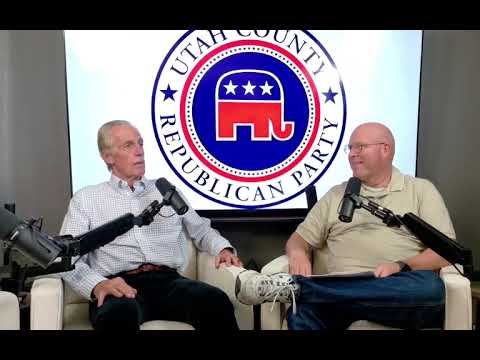
In a Utah County Republican Party podcast interview, candidate Larry Evans says commissioner pay is "too high," pledges to limit property-tax increases to inflation, favors shrinking the commission office and moving to a five-member district-based commission, and stresses agricultural protection and cautious use of tax incentives.
Larry Evans, a candidate for Utah County Commissioner Seat A and a deputy with the Utah County Sheriff’s Office, framed his run as a return to public service and outlined a slate of priorities that include lowering commissioner pay, restraining property-tax growth and protecting family farms.
Evans, who said he has 42 years in law enforcement, 26 years with the Utah Department of Corrections, taught criminal justice at Utah Valley University and serves on the State Retirement Board, told host Charles Maxwood he did not seek office for the money. "I think the salary is too high," Evans said of the current commissioner pay, and suggested a figure "somewhere in the ballpark of $80,000 to $100,000" would be more appropriate while proposing structural changes—four district seats and one at-large seat—to make commission service more part-time and lower costs.
On property taxes, Maxwood cited prior large increases. Evans said county residents should expect transparency and that the county receives a small share of total property-tax bills, but he stopped short of promising never to raise taxes. "I'm not going to commit that I won't raise taxes in a 4-year period," he said, but added he was "comfortable" committing to increases only at the inflationary rate if elected.
Evans criticized what he described as excessive growth in the commission office staff from historical levels of about six positions to the multiple‑dozen figures reported by the host. "That's way too much fat at the top," he said, and urged hiring freezes, vacancy management and careful evaluation of positions before expanding the office.
On the county’s form of government, Evans said he favors five commissioners elected by district (with one at-large) over a mayor–council model, saying a district-based system would better reflect different local needs across Utah County.
Public safety and law-enforcement experience shaped Evans’s views on pandemic policy and immigration. Asked about the county’s 2020 mask mandate, he said he understood the rationale and "would have voted for the mandate," while conceding it was difficult for many residents. On a county cooperative agreement with U.S. Immigration and Customs Enforcement, Evans said he would have approved the agreement in principle, calling ICE’s "marching orders" sometimes heavy-handed and endorsing the need for immigration reform.
Evans made agricultural protection a campaign priority, advocating for green-belt and farm‑tax protections to keep family farms and orchards viable. He also said he is still learning about water policy but opposes projects that would prioritize industrial water use ahead of residents’ needs.
On local infrastructure and sales-tax allocations, Evans described transit and FrontRunner as valuable investments while saying he would want data to judge the Utah Valley Express (UVX) line’s success. He said he was uneasy about the county’s airport commitments — an initial $19.5 million contribution and a reported interlocal promise of $3.5 million a year for 15 years — because long-term earmarks can crowd out future priorities.
Evans said he has self-funded the campaign so far and would accept donations only if he advanced to contests that require broader fundraising. He pledged open office hours and more accessible commission meetings, and said he favors "one and done" single four‑year terms to prevent entrenched incumbency while acknowledging some voters prefer two terms for continuity. He closed the interview by urging civility in local politics and promising to prioritize listening to residents.
Evans provided a campaign website and an email address during the recording; the audio transcript records those contact strings unclearly, so the campaign contact details were not reliably captured in the record.