Get Full Government Meeting Transcripts, Videos, & Alerts Forever!
Get email alerts on the Facilities Master Plan topic
No spam. Unsubscribe anytime.
Poway Unified outlines $1.78 billion facilities need, reports $97 million in capital and seeks voter testing for a bond
Summary
District staff presented a refreshed facilities master plan and deferred-maintenance inventory on Sept. 29, 2025, saying remaining needs total about $1.78 billion while local capital stands near $97 million and state eligibility about $119 million; the board asked staff to test a potential bond with voter research.
Poway Unified School District leaders told the school board on Sept. 29 that the district’s refreshed facilities master plan and new deferred-maintenance inventory identify roughly $1.78 billion in remaining needs, while available local capital totals about $97 million and current state eligibility is about $119 million.
The assertion came as facilities staff summarized summer projects and a new, site-by-site deferred-maintenance database intended to prioritize urgent repairs such as roofing, HVAC and flooring. “This database allows us to filter and forecast out 10-plus years,” assistant director Ron Trimner said during the workshop presentation.
Why it matters: staff said the district faces a funding gap that cannot be closed with current local resources alone. Staff estimated that urgent and critical deferred-maintenance items identified in the plan total about $26.5 million (primarily roofing, HVAC and flooring replacement), and that larger modernization projects across the district are part of the $1.78 billion figure.
Facilities staff emphasized two compounding budget pressures: rising construction costs and limits on near-term state reimbursements. The district showed a California Construction Cost Index trend that included double-digit escalation in recent years, and staff warned that earlier cost estimates must be escalated to account for those increases.
On funding, staff outlined current sources: general-fund restricted maintenance allocations, a $1 million annual transfer to Fund 14 for deferred maintenance, developer and CFD (community facilities district) revenues tied to growth, and historic state reimbursement eligibility. “We do not have the $119 million in cash today; that figure reflects state eligibility that requires local front funding and later reimbursement,” a facilities presenter told the board.
The board also heard that the Rancho Bernardo chiller project (a stand-alone, high-cost HVAC project) is being financed and tracked separately and will be presented to the board in a future meeting.
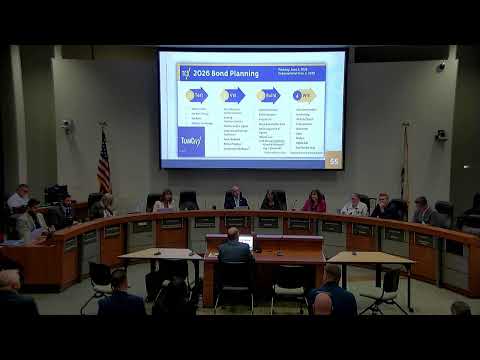
Board response and next steps: after questions about prioritization and how projects are matched to available funding, the board signaled consensus for staff to pursue voter testing. The district invited consultants Jared Boen (Team Civics) and Dr. Tim McCclar (True North Research) to explain a three-stage bond-creation process—test, vet and build—and the timeline constraints for a potential November 2026 measure. Dr. McCclar said the initial scientific survey typically takes two to three months and is intended to determine whether a bond can be sized and structured to match voter priorities.
If the board chooses to proceed, staff said they will return to the board with a formal proposal to contract for polling and vetting work and to present a project list refined to community priorities. The board placed a staff report and a contract proposal for consultant-led voter research on the agenda for potential action at a future meeting.
All figures and timelines reported at the Sept. 29 workshop were presented by district staff during the facilities master plan and deferred-maintenance sections of the meeting.