Get Full Government Meeting Transcripts, Videos, & Alerts Forever!
Get email alerts on the Renewable Energy Siting topic
No spam. Unsubscribe anytime.
Residents urge stronger protections on farmland, wildlife and public safety over wind, solar and battery projects
Summary
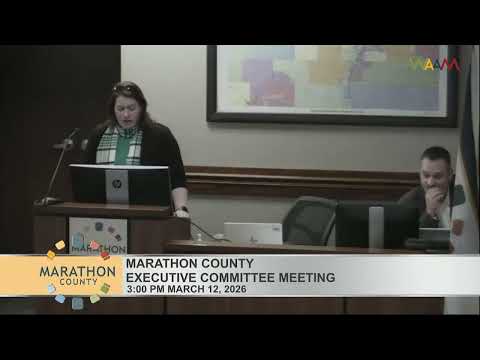
At the Marathon County Executive Committee hearing, multiple residents and farmers urged stronger Comprehensive Plan language to protect farmland, prime soils, wildlife and local infrastructure, and raised health, emergency-response and property-value concerns related to utility-scale wind, solar and battery storage projects.
Multiple residents, landowners and farmers told the Marathon County Executive Committee during its public hearing that the Comprehensive Plan 2026 should include clearer, stronger language to protect farmland, wildlife and public safety from the impacts of utility-scale wind, solar and battery storage projects.
Cindy Nelson of Stratford said heavy equipment for turbine construction will damage gravel township roads and asked who will be responsible for repairs: "Who is going to be repairing the roads? Is it going to be the county or is it going to be the township?" She also raised concerns about soil contamination if turbines leak fluids and about emergency response needs for battery storage fires.
Mike Lang, who said his town is in the Hub City Wind project area, raised health concerns and cited local history with the Shirley Wind project, arguing developers test for audible noise but not for infrasound. "Windmill companies test for noise, but they do not test for infrasound," Lang said; the transcript contains references to complaints of insomnia, headaches and dizziness from residents in a prior project but does not include an expert report to adjudicate those claims.
Heidi Pesky and other witnesses urged the county to add explicit protections for wildlife habitat. Pesky cited U.S. Fish & Wildlife materials on species avoidance and collision risks and asked planners to factor in protective buffers for sensitive migration routes, warning that placing industrial-scale turbines and solar between protected wetlands and wildlife areas could impede species reintroduction and foraging habitat.
Other speakers described worries that farmland could be converted to industrial energy uses, that property values may decline, and that lithium-ion battery storage sites create different fire and contamination risks than typical agricultural uses. Several speakers asked for a citizens’ task force, better public education and explicit language recognizing utility-scale energy projects as industrial land uses rather than typical farm activities.
What the committee said: Supervisors and staff acknowledged the concerns and repeatedly noted statutory limits on local authority when certain projects fall under state jurisdiction. Supervisor Boots and others suggested negotiated agreements with developers could include road-repair, ecological assessment and decommissioning provisions, but committee members also discussed litigation risks and the need for state-level advocacy if local regulatory authority remains constrained.
Quote: "This plan should also acknowledge that large energy facilities alter the character of our rural communities," Wendy Regulski told the committee.
What wasn’t decided: Committee members did not adopt new zoning or regulatory language at the hearing; instead they asked staff to collect public comments and suggested edits and to present them to the full County Board at an educational meeting. No binding changes were made at this meeting.