Get Full Government Meeting Transcripts, Videos, & Alerts Forever!
Get email alerts on the Criminal Justice topic
No spam. Unsubscribe anytime.
Michigan Supreme Court weighs whether lawful marijuana use can trigger probation revocation
Summary
In oral argument in People v. Hess, defense counsel said Michigan's voter-approved recreational marijuana law bars revoking probation for otherwise lawful marijuana use; prosecutors argued the probation statute and public-safety concerns allow courts to impose abstinence as a condition for probationers.
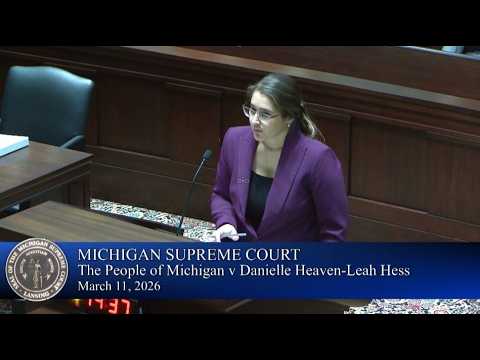
The Michigan Supreme Court heard argument on whether a person's lawful, state-authorized marijuana use may serve as the basis for revoking probation in People of the State of Michigan v. Danielle Hess.
"We ask this court today to overturn People versus Hess and People versus Lopez Hernandez and to hold that the state legal use or possession of marijuana cannot be the basis for a probation violation in Michigan state courts," defense attorney Emma Lotton told the justices, asking the Court to treat the Michigan voter-approved marijuana law as a bar to punishing lawful personal use.
Lotton told the court the Michigan Regulation and Taxation of Marijuana Act (referred to repeatedly in argument) places lawful possession and use "beyond the power the punishing power of the state," and she urged the justices to read the statute as a flat prohibition on penalties or privilege revocations tied to lawful use. She said the client's plea reduced her charge to a misdemeanor (retail fraud third), did not negotiate a marijuana-abstinence condition, and that the trial court later relied on lawful marijuana use to upwardly depart and impose jail despite the absence of an MRTMA violation in the underlying offense.
A justice pressed whether overturning People v. Lopez Hernandez was necessary to resolve Hess's case and whether a narrower rule (limiting relief to defendants not convicted of an MRTMA offense) would suffice. Lotton said the plain text covers both medical and recreational lawful conduct and argued there is no "spectrum" in the statute: the act's text, she said, "says no penalty of any kind."
The bench and counsel debated analogies to other constitutional rights and conditions of probation: working at a marijuana dispensary; agreeing to court-ordered searches; or waiving rights to possess firearms. Lotton said MRTMA's voter-enacted language is intended to preclude courts from using lawful marijuana conduct as a basis for punishment, and that specialty courts had been carved out by later legislative amendments to address treatment-court operations.
Tom Ginster, arguing for the People, told the Court the probation statute and the recreational-marijuana law can coexist. "The recreational marijuana law defines what law-abiding citizens can do. The probation act defines what a probationer must refrain from doing," he said, emphasizing the longstanding principle that probationers do not enjoy the same liberties as other citizens and that courts regularly impose substance-abstinence conditions tied to rehabilitation.
Ginster asked the justices to focus on statutory construction and precedent, arguing implied repeal is disfavored and that the plain terms of the probation statute (cited during argument) permit conditions that require a probationer to obey criminal laws, including federal prohibitions. He noted the court of appeals had affirmed the trial court's authority to impose marijuana-related probation conditions in the lower-court proceedings.
Both sides acknowledged practical problems. Defense counsel said individual assessments and legislative fixes shaped the response for specialty courts; the People's counsel said individualized screening for every misdemeanor would be impractical and that courts frequently rely on standard conditions to aid rehabilitation. Justices repeatedly probed whether a negotiated plea that explicitly included a marijuana condition would change the remedy and what relief would follow if the condition had not been bargained for.
The case was submitted after argument; the court did not announce a decision. The justices will decide whether the MRTMA bars courts from revoking probation based on otherwise lawful marijuana use or whether the probation statute permits abstinence conditions for supervised defendants.
Background: The argument centered on the interplay between Michigan's probation statute (discussed at argument as governing permissible conditions for probationers) and the voter-approved Michigan Regulation and Taxation of Marijuana Act. Counsel referenced appellate decisions including People v. Lopez Hernandez and other cases addressing similar statutory tensions; the bench discussed remedies such as striking unlawful probation conditions or allowing prosecutors to revoke negotiated pleas when a specific term was bargained for.
What happens next: The court took the case under advisement and will issue an opinion resolving whether lawful use of marijuana under state law can, by itself, justify probation revocation.