Get Full Government Meeting Transcripts, Videos, & Alerts Forever!
Get email alerts on the Cell Phone Policy topic
No spam. Unsubscribe anytime.
Modesto schools plan task force, survey and trainings to implement state 'phone‑free' law
Summary
Following AB 3216, Modesto City Schools will form a stakeholder task force this fall to craft a districtwide phone policy, survey students and families and aim for board review in April 2026 and implementation on July 1, 2026. District leaders stressed enforcement consistency and exceptions for medical needs.
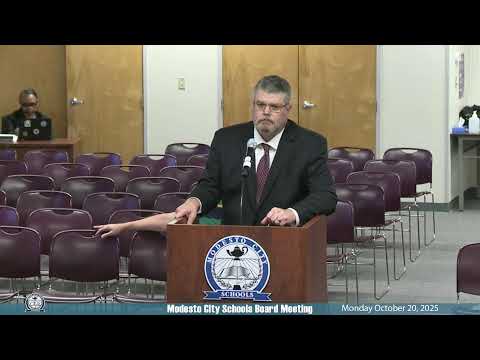
Modesto City Schools outlined a timeline on Oct. 20 to prepare for Assembly Bill 3216, the state’s Phone‑Free Schools Act, which requires districts to adopt policies limiting or prohibiting student smartphone use during supervised school time.
Senior Director David Hal told trustees the district’s current rule allows students to possess phones but requires them to be turned off and out of sight unless used for instruction, and that the new law requires a formal review and stakeholder engagement. "AB3216 requires that by July 1 of 2026, all districts adopt a policy that limits or prohibits student smartphone use at school or during school supervised times," Hal said.
Hal proposed a process that begins immediately: assemble a broad task force (October 2025), hold task‑force meetings in November, distribute a district survey to students, families and staff in January 2026, have executive cabinet review the task‑force recommendations in April, and, if approved, implement the district policy on July 1, 2026. Hal acknowledged enforcement concerns: Education Code constraints on suspensions (48900(k)) and inconsistent school‑by‑school application of existing rules.
Teachers and staff who addressed the board urged a firm approach. "If current policy worked, we wouldn't need to change," said Handshaw Middle teacher Jason Flor, who urged an "all‑day cell‑phone ban from day one, minute to minute, all day long," while acknowledging medical exceptions should be preserved. He and other speakers said devices are a frequent source of classroom distraction, cyberbullying and lost instructional time.
Trustees discussed models used elsewhere — bags, locked pouches, centralized check‑ins, or full bans — and emphasized that any successful policy will require 100% staff buy‑in and consistent enforcement by teachers, campus supervisors and administrators. Several trustees also called for examining evidence from other districts and collecting post‑implementation data on behavior and academic outcomes.
Next steps: the district will assemble the task force and gather community input; cabinet will review recommendations in April 2026. If the board approves changes, communications, staff training and an implementation plan are scheduled ahead of the statutory deadline of July 1, 2026.