Get Full Government Meeting Transcripts, Videos, & Alerts Forever!
Get email alerts on the Student Discipline topic
No spam. Unsubscribe anytime.
Teachers and staff urge stronger discipline and consistent supports at Modesto City Schools meeting
Summary
At the Oct. 20 Modesto City Schools board meeting, dozens of teachers and classified staff recounted violent and disruptive classroom incidents and pressed the board to improve consistency of consequences, expand behavior supports and provide targeted training for elementary classrooms.
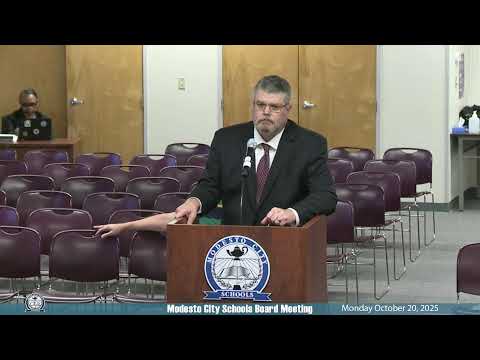
More than a dozen teachers, paraprofessionals and union representatives told the Modesto City Schools board on Oct. 20 that repeated classroom violence and chronic disruptive behavior are undermining instruction and staff safety.
At the heart of the meeting was an hour‑long public‑comment block during which teachers described incidents including repeated elopement, students throwing furniture and objects, biting and punching, and at least one case of a student stabbed with a pencil. "These behaviors make it impossible for the other kids to learn," said a teacher who identified herself as Jennifer, urging the board to "allow us to make our schools safe and stop being afraid of holding students and their parents accountable for their behavior." Many speakers said administrators sometimes returned disruptive students to class with little or no discipline, or assigned office rewards such as popsicles or toys that staff said reinforced bad behavior.
The district presentation that preceded public comment framed the issue as complex and partly rooted in changes to state law and student needs. Mark Hurst, who introduced the report, told trustees the district has shifted away from punitive practices over the past two decades and invested in positive behavioral interventions, restorative practices and mental‑health clinicians. He and senior directors David Hal and Christina Romero highlighted that state law (Education Code 48900(k)) has narrowed the scope for suspensions for "willful defiance," and that much of the district’s current work focuses on early‑grade behavior and providing in‑school supports. "We provide social‑emotional learning, behavioral supports and functional behavior analyses," Romero said, describing the role of board‑certified behavior analysts in assessing students and developing plans.
District data presented at the meeting showed the highest immediate challenge is in grades PK–2, with an increase in referrals for special‑education assessment and more students being placed in non‑public or segregated settings. Hurst said the district has expanded Student Assistance Specialists from roughly 20 in 2021 to about 70 and increased full‑time mental‑health clinicians from 12 to 29 in recent years.
Board members and district leaders responded that they would work to improve consistency in consequences and administrator decision‑making. Associate Superintendent David Hal said the district will hold "disciplinary consequences calibration trainings" with site administrators and that the cabinet will plan additional supports, including a proposed district behavioral symposium and increased professional development on de‑escalation and trauma‑informed practices.
Trustees emphasized limits imposed by state law and the need for community partnerships and family engagement to address early‑age behavior. Several trustees asked the district to include teachers and classroom staff in developing solutions. "We need consistency and a plan that includes the people in the trenches," Trustee Irvin said.
What happens next: the district plans administrator calibration trainings and broader staff training, continued investments in BCBAs and mental‑health clinicians, and further community engagement to craft school‑level plans. Trustees did not take a formal vote on new discipline policy at the meeting; instead, staff outlined implementation steps and additional training that the district will deliver in the coming months.