Get Full Government Meeting Transcripts, Videos, & Alerts Forever!
Get email alerts on the Events Permitting topic
No spam. Unsubscribe anytime.
Oregon City commission seeks clearer rules for Main Street closures, directing staff to draft a stricter permitting framework
Summary
After months of business complaints about street closures, the Oregon City Commission this week asked staff to draft a structured policy for events that close Main Street, including stricter notice, a possible tiered approval system and an appeals path for one‑off requests.
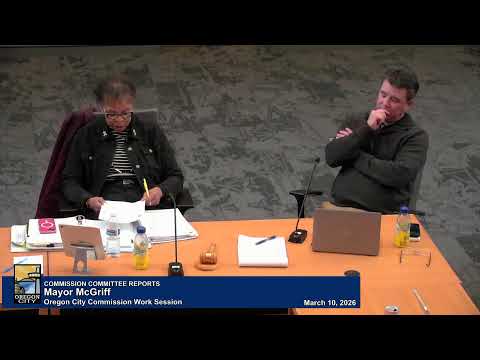
Oregon City commissioners on March 10 pressed staff to develop clearer, citywide rules for events that close streets — with Main Street singled out for stricter notice and approval because it lacks nearby alternate routes and concentrates downtown businesses.
The conversation, launched by Mayor McGriff and led by the city manager’s office and event staff, reviewed the city’s existing event types — rights-of-way closures, park rentals and film permits — and the internal review team that draws on parks, public works and police depending on an event’s impacts. Staff said the city recently extended required notification for street‑closure events from five to 10 days after receiving public comment, but commissioners said that remains too short for many downtown businesses.
Ann Griffin, economic development staff, told the commission the current film‑permit rule requires “at least 7 days notice for a film permit. So, if I wanted to close Main Street downtown and film, I could give 7 days notice to the businesses down there.” She and permitting staff also noted the city’s practice of giving recurring events template packets and working with applicants to reduce last‑minute problems.
Commissioners debated a range of fixes: identifying a small set of longstanding “signature” events that would be pre‑authorized to close Main Street; creating an administrative tier for lower‑impact closures while reserving commission review for high‑impact or new events; lengthening notification specifically for Main Street to two to four weeks; and requiring credible proof that affected businesses and residents were notified rather than relying solely on social media posts.
“Main Street is different,” one commissioner said during debate, pointing to the lack of parallel streets and the concentration of downtown businesses. Several commissioners suggested standard windows between 15 and 30 days for Main Street notices and recommended staff research practical verification methods (door notices, business acknowledgments, certified mail or documented hand delivery) and cost implications.
Staff warned that many local nonprofit applicants currently submit permit materials piecemeal and said stricter advance deadlines would require earlier applicant planning and would likely prompt complaints. Still, the commission agreed on a policy goal: reduce unpredictable downtown closures while preserving a path for high‑quality new events to be considered.
The commission directed staff to draft a structured framework that defines the affected downtown area, differentiates administrative approvals from commission approvals (and an appeals/exception process), recommends notice timelines by location and event type, and proposes verification measures for notifications. Staff was asked to return with a proposed policy or code amendment for further commission review.
Next steps: staff will prepare a draft policy with options for notice periods and verification methods; the commission signaled interest in higher notification minimums for Main Street and a clear process for one‑off exceptions and film projects.