Get Full Government Meeting Transcripts, Videos, & Alerts Forever!
Get email alerts on the Planning Process topic
No spam. Unsubscribe anytime.
Planning board holds in‑depth training on land‑use tools, density and MIHOP bonuses
Summary
Principal Planner Curtis Thompson led a March 12 workshop for Riviera Beach’s Planning & Zoning Board explaining the future land‑use map, rezoning, site plan review, PUDs, floor‑area ratio and MIHOP bonus rules (including a 25‑story/300‑ft cap under the IAPUD bonus).
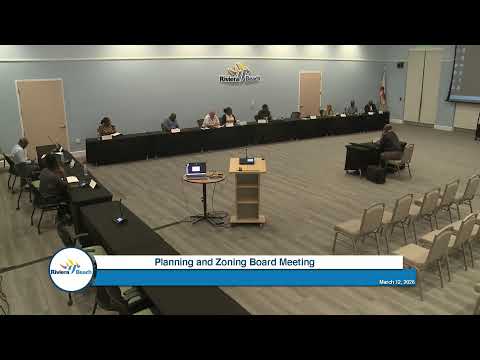
Principal Planner Curtis Thompson led a training session for the Riviera Beach Planning & Zoning Board on March 12 that walked new and returning members through the city’s core land‑use tools and review responsibilities.
Thompson told the board the future land‑use map (FLUM) is “a key component of a comprehensive plan” that shows the city’s long‑term preferred development pattern but is not itself the legal zoning map. He described the formal process for FLUM amendments, distinguishing small‑scale amendments (under 10 acres) from large‑scale changes that require state review.
Thompson also reviewed zoning map amendments and site plan review, telling members the city’s process checks setbacks, parking, drainage, landscaping and public‑safety concerns. On the technical side he explained floor‑area ratio (FAR) as a measure of building bulk and showed how FAR, setbacks and parking interact to limit building mass. “F is an effective way to calculate the bulk and mass of building volume on a development site,” he said.
Staff answered member questions about density and bonuses. Mr. Surmans (director) offered a worked example of density limits: if an RM20 district allows 17 units per acre without bonus, a 2‑acre lot would cap at 34 units under the base rules. Thompson and staff described MIHOP (the Minority and Housing Opportunity Plan, city code chapter 26) as an incentive program that can yield bonuses—such as the IAPUD bonus—that increase height and density in exchange for requirements like minority hiring and affordable‑housing contributions.
Thompson noted code limits for tower height under the IAPUD bonus: “With the implementation of the MIHOP, they can get that extra 60 feet or 300 feet and no more than 25 floors,” he said, adding that earlier drawings showing 28 stories would exceed code and would not be permitted at decision time.
He reviewed the four formal recommendation options available to the board—recommend approval, approval with conditions, recommend denial (with stated reasons) or continue to a date‑certain—and emphasized that the board’s role is advisory to the city council. Staff urged members to record reasons when recommending denial so council receives a clear justification.
Why it matters: The training clarified how technical standards (FAR, setbacks, parking, drainage) and incentive programs (MIHOP/IAPUD) shape what developers can propose and what the board can recommend to council. That context will guide the board’s recommendations on upcoming mixed‑use and waterfront projects.