Get Full Government Meeting Transcripts, Videos, & Alerts Forever!
Get email alerts on the Traffic Calming topic
No spam. Unsubscribe anytime.
NDOT presents speed cushions, striping and bulbouts for Boyd Drive; neighborhood ballot required
Summary
At a Feb. 5 virtual meeting, the Nashville Department of Transportation unveiled a design for Boyd Drive that includes speed cushions, a radar feedback sign, narrowed lanes with a marked "slow, safer shoulder" and bulbouts; the project will proceed only if two-thirds of returned neighborhood ballots approve it during a six-week vote.
The Nashville Department of Transportation on Feb. 5 presented a traffic-calming plan for a segment of Boyd Drive that would install speed cushions, a radar feedback sign, narrowed vehicle lanes with a marked "slow, safer shoulder" and bulbouts to reduce speeds and improve pedestrian comfort.
NDOT civil engineer David Greavves led the virtual meeting and said the project grew out of a program that prioritizes neighborhood streets for safety and walkability. Greavves said Boyd Drive was one of 25 streets selected in fall 2025 from about 700 applications and that NDOT’s data analysis and site visits informed the current design. "This is a program that focuses on residential streets," Greavves said, adding that NDOT emphasizes engineering solutions while enforcement remains with the Metro Nashville Police Department.
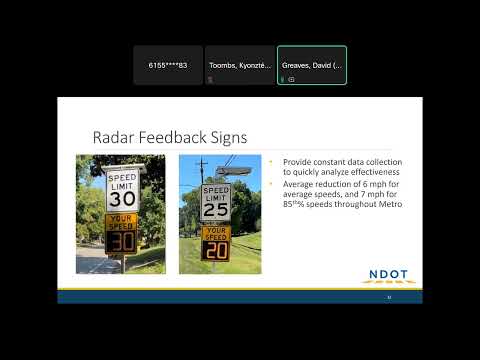
Greavves said NDOT proposes modular rubber speed cushions bolted to pavement at multiple locations along the applied segment; cushions are intended to reduce prevalent high speeds without the severity of a full speed bump. Citing before-and-after data from several Nashville projects, Greavves said average speeds on similar streets dropped from roughly 31 to 22 mph and 85th-percentile speeds fell from about 37 to 25 mph. Where slopes or curves make cushions unsafe, NDOT proposes an informational radar feedback sign oriented uphill to remind drivers of their speed.
A resident who identified themselves as living on Boyd Drive told the meeting participants that vehicles often travel "over 50 60 miles per hour" on the street and said speed cushions would probably help. Greavves responded that the speeds described were higher than desired and that the proposed cushions and striping aim to bring speeds down to a safer range.
Additional elements in the design include lane striping to narrow travel lanes (NDOT said the design generally maintains lane widths in the neighborhood range), a marked shoulder area with delineators meant to give pedestrians more comfortable space, and bulbouts to shorten crossing distances and reduce turning speeds at intersections. Greavves said the presentation shows three sets of speed cushions before a steep hill and additional sets on the straighter sections; the cushions on the straightaway were described as spaced roughly 400 feet apart in the plans.
NDOT emphasized that vertical treatments like cushions require neighborhood approval through a ballot process. Greavves explained that NDOT mails ballots to property owners that touch the affected street, that ballots are open for six weeks, and that the project will only move forward if two-thirds of returned ballots are "yes." The agency limits ballots to residential property owners plus qualifying churches and schools and excludes operating businesses; owners with multiple properties receive a single ballot. Greavves said NDOT will provide manual ballot access codes if a household believes it should have received a card but did not.
No formal decision was made at the meeting; Greavves said NDOT will prepare and mail the ballots and that project construction would proceed only if the ballot threshold is met. The meeting recording and materials will be posted by NDOT and Greavves offered his contact information for follow-up questions.