Get Full Government Meeting Transcripts, Videos, & Alerts Forever!
Get email alerts on the Workers Compensation topic
No spam. Unsubscribe anytime.
Committee advances Cruz bill adopting ODG guidelines for workers’ compensation with two‑year trial
Summary
The House and Labor & Industrial Relations Committee voted 7–6 to report House Bill 819, which would adopt the Official Disability Guidelines (ODG) by MCG/Hearst as the primary medical treatment schedule for Louisiana workers’ compensation on a two‑year trial with a sunset/reversion if expected savings don’t materialize.
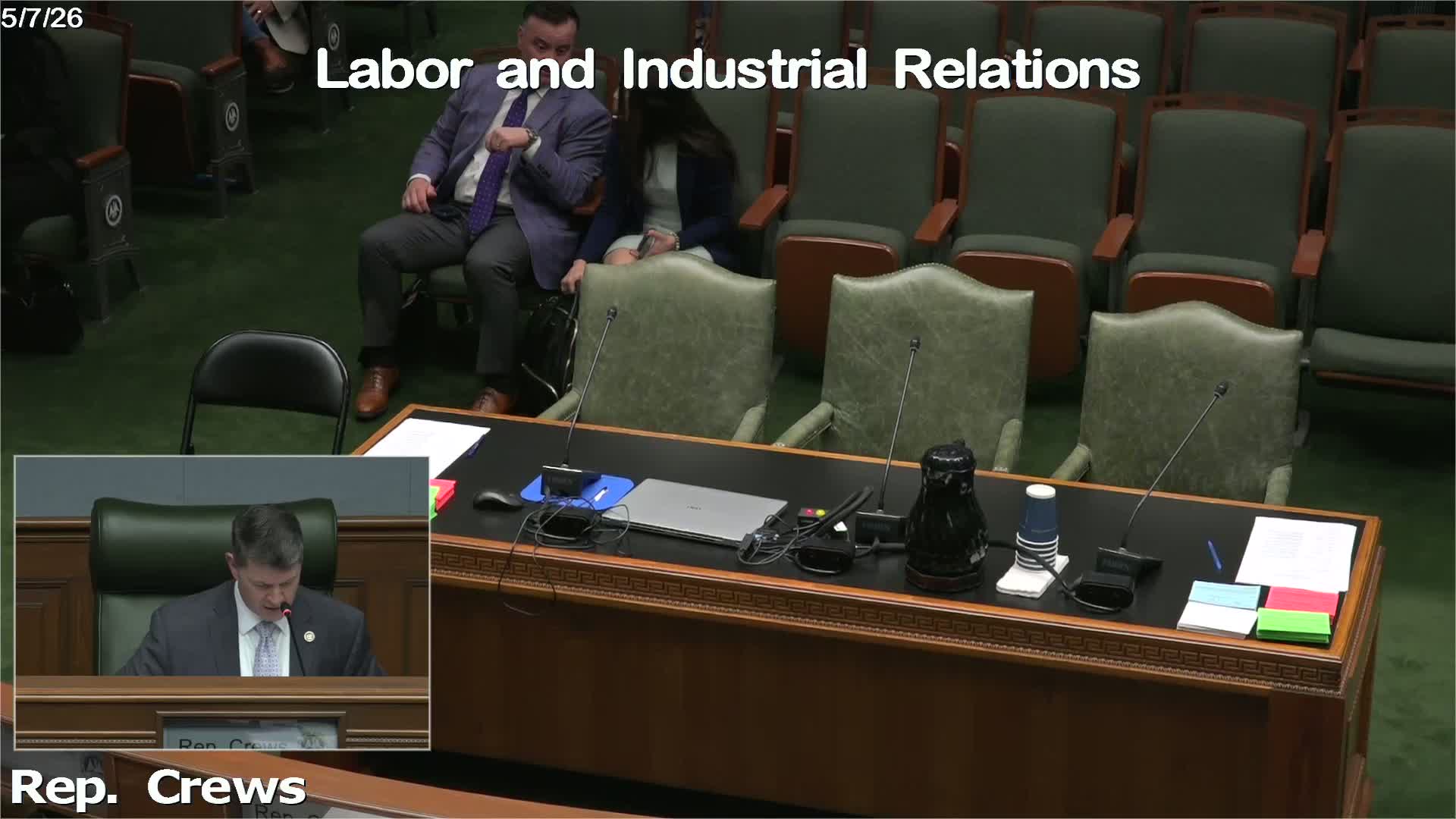
Chairman Cruz presented House Bill 819 on May 7, asking the committee to replace the state’s current medical treatment schedule for workers’ compensation with the Official Disability Guidelines (ODG) by MCG, a Hearst Health company, and the panel adopted a trial amendment before narrowly sending the bill forward.
Cruz said the change would align Louisiana with a nationally maintained, evidence‑reviewed set of guidelines that proponents say shortens disability duration and reduces claim costs. "It compiles evidence and gives physicians a resource to expedite claims," Cruz said, adding that adoption would cost physicians about $400 per site per year but would not require general‑fund spending.
The bill’s author and ODG witness, Troy Prevost, described the product as a continuously updated editorial guideline reviewed by physicians and statisticians. Prevost told the committee ODG is used as a statutory primary guideline in 13 states and is available to clinicians in all 50. State Medical Director Jason Picard and Brian Blackwood, assistant secretary for the workers’ compensation section, appeared for the agency to confirm that emergency care and the variance/appeal routes to the medical director would remain unchanged under the proposal.
Opposition witnesses and some members raised concerns about outsourcing the state schedule to a private company and about potential automatic denials. Joseph Jola Saint of Louisiana Workers said ODG ‘‘is essentially cookie‑cutter care’’ and asserted it could drive denials and exclude local clinicians’ judgment. Injured‑worker advocate Robin Krumholt and others cited outside analyses critical of ODG’s technical quality in specific contexts and argued the committee should preserve the local advisory council’s role. Krumholt urged the committee to consider tacit approval changes to the current system instead of replacing the schedule.
Committee debate focused on three practical points: whether ODG would speed approvals and reduce the duration of disability; the $400 subscription cost and who would pay it; and procedural safeguards for patients and providers. Dr. Picard said he uses ODG as a secondary guideline today for gaps in the Louisiana schedule, estimated ODG use at roughly 20–25% in his daily work, and said a transition to ODG would not change the appeals process to the medical director.
Representative Glorioso secured and read a committee amendment in concept that would allow providers to follow either the Louisiana State Medical Treatment Guidelines or ODG and add a tacit‑approval mechanism so that care consistent with either schedule would be treated as approved without prior authorization; the amendment would also require insurers to pay providers within 30 days and would require a high "clear and convincing" standard for carriers to later challenge care that followed an approved schedule. The amendment also creates a two‑year trial/sunset provision: if the ODG‑based schedule does not produce specified reductions within two years, the statute would revert to present law.
After amendment adoption, committee roll call produced a 7–6 favorable report on the bill as amended. The committee clerk announced the tally and the chair said he would work further on on‑ramp language and other technical changes ahead of floor consideration.
What happens next: HB 819 was reported favorably out of committee as amended. The bill will proceed to the House floor with the two‑year trial language; supporters and opponents told the committee they expect to submit additional technical language before floor debate to clarify implementation and to provide a mechanism for workers already in treatment when the new schedule takes effect.
Sources: testimony and Q&A with Chairman Cruz, Troy Prevost (ODG/MCG), Dr. Jason Picard (state medical director), Brian Blackwood (assistant secretary), and public commenters during the committee hearing. The committee adopted amendment set 50‑53 and reported HB 819 favorably by roll call.