Get Full Government Meeting Transcripts, Videos, & Alerts Forever!
Get email alerts on the Accessory Dwelling Units topic
No spam. Unsubscribe anytime.
Menlo Park Planning Commission studies ADU ordinance update, hears sewer review warning from West Bay Sanitary District
Summary
City staff presented a draft update to Menlo Park's accessory dwelling unit (ADU) ordinance to align local rules with state law and propose limited local objective standards; commissioners probed size, access, parking and process questions, and West Bay Sanitary District said the city approved "over 400 ADUs" without district sewer review.
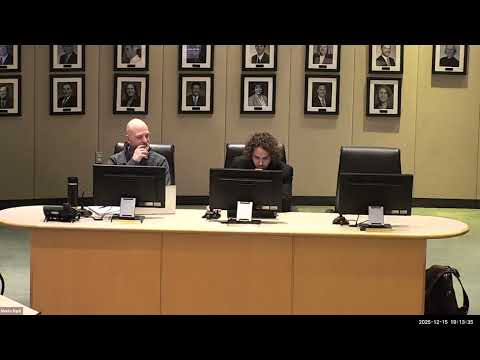
Menlo Park 'City staff presented a draft update to the city's accessory dwelling unit (ADU) ordinance at a Dec. 15 Planning Commission study session and sought feedback on how to bring local rules into compliance with state law while adding limited objective standards for ADUs that are not state-mandated.
The presentation by Associate Planner Matt Pruder laid out two broad ADU categories: state-mandated ADUs (including internal conversions and junior ADUs, detached ADUs up to 800 square feet and certain multifamily conversions) that receive ministerial review under state law, and non-state-mandated ADUs (for example, detached ADUs larger than 800 square feet and attached ADUs) that could be subject to locally adopted objective standards. Pruder said the draft is an initial proposal and that staff will revise it after Commission feedback and a required 60-day review by the State Department of Housing and Community Development (HCD).
Why it matters: the city received a Dec. 5 letter from HCD noting potential inconsistencies with state law and Menlo Park's 2023'031 Housing Element (Program H4F) requires the ADU ordinance be in compliance. Commissioners said a clear, locally useful ordinance is important both to meet state requirements and to give residents practical guidance.
Key details and debate
Sewer and interagency coordination: Sergio Ramirez, general manager of West Bay Sanitary District, told the commission the district recently learned "of over 400 ADUs which have been approved by the City of Menlo Park without the benefit of the district's review for sanitary sewer service." Ramirez asked how the ordinance could ensure ADUs are evaluated for sewer-service capacity, easement conflicts and separate lateral/service-billing so utilities can collect appropriate charges. Staff acknowledged coordination issues and said the draft would clarify utility, sanitary sewer and fire-review steps and that staff is working with the district to address past approvals.
Size and ministerial review: Staff clarified that some earlier slides contained errors: there is no fixed 1,000-square-foot cap on internal ADUs per the most recent guidance. City Attorney Nira Doherty told the Commission that "state laws do not reserve to city discretion the ability to impose a maximum size limit on Section 66323 internal conversion ADUs," meaning that internal conversion ADUs are not subject to a local maximum set by the city. Commissioners sought clarity on when a proposed ADU is treated as a state-mandated ministerial project versus a locally regulated ADU and how the draft handles the "guaranteed allowance" that accommodates an 800-square-foot ADU beyond local floor-area maximums.
Access, parking and design standards: Commissioners debated whether to require exterior-only access to ADUs (which can encourage units that operate independently) or allow interior access (which some homeowners prefer). Several commissioners expressed concern that prohibiting interior access could discourage ADU construction. The Commission also discussed parking: staff said state law largely prevents parking standards for state-mandated ADUs but allows up to one required space for other ADUs, and exemptions may apply in locations where overnight on-street permits are restricted.
Permissibility vs. simplicity: Commissioners voiced two recurring themes: some favored limiting local standards to reduce conflicts with evolving state law and to keep rules simple; others urged using the local ordinance to expand permissibility (for example, higher maximum ADU sizes, taller height limits and fewer parking minimums) to encourage more ADUs and housing supply. Several commissioners asked staff for more data on how existing ADUs are used (rental vs. owner-occupied) to inform policy choices.
Process and next steps: Staff described the intended process: staff will revise the draft based on Commission feedback, consider HCD review during the required 60-day HCD review window, return to the Planning Commission in the first quarter of 2026 for further review, and then forward recommended amendments to City Council for two readings and possible adoption in the second quarter of 2026.
Vote and formal actions: No ordinance was adopted; the Planning Commission held a single consent vote earlier in the meeting to approve the Nov. 17 minutes with an added sentence. The consent item passed on roll call with five votes in favor, one abstention and one absence.
What to watch next: Staff will return with a revised draft and clarifications in Q1 2026; HCD will also review the updated ordinance during a statutorily required 60-day review period. The Commission asked staff to provide clearer language about the guaranteed allowance, covered-porch proportionality and the treatment of interior access, and to coordinate with West Bay Sanitary District on sewer-review procedures.
Quotes
"These are initial inputs for your consideration," Associate Planner Matt Pruder said, asking commissioners for early feedback.
"Of over 400 ADUs which have been approved by the City of Menlo Park without the benefit of the district's review for sanitary sewer service," Sergio Ramirez said, urging the city to address utility-review gaps.
"State laws do not reserve to city discretion the ability to impose a maximum size limit on Section 66323 internal conversion ADUs," City Attorney Nira Doherty said when commissioners asked whether local maximums could be imposed on internal conversions.
Next procedural step: Staff will revise the draft ordinance and present updates to the Planning Commission in Q1 2026, followed by City Council hearings and HCD's 60-day review.