Get Full Government Meeting Transcripts, Videos, & Alerts Forever!
Get email alerts on the Behavioral Health Response topic
No spam. Unsubscribe anytime.
Spokane police outline push for 24/7 crisis care and unveil gun‑crime pilot
Summary
Spokane Police Chief Hall told the council the department is pursuing a 'third‑place' 24/7 crisis facility, embedding clinicians in dispatch and pilot night responder teams, and announced a six‑person Gun Crime Unit aimed at reducing gun‑related incidents 10% by December 2026.
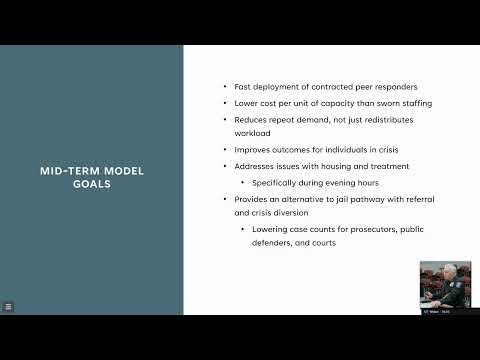
Chief Hall told the Public Safety & Community Health Committee that Spokane is trying to close gaps in crisis care and cut unnecessary emergency room handoffs by building out a 24/7 crisis‑response model and embedding clinicians in dispatch.
“We're hoping to build an infrastructure that can support a 24/7 model,” Chief Hall said, explaining the goal of phone stabilization and clinician‑assisted dispatch to stabilize callers and, when needed, send mobile crisis teams rather than patrol officers.
Hall described a recent February case in which an individual who had been involuntarily committed and referred for follow‑up later died by suicide, using the episode to argue the region lacks capacity for sustained, high‑acuity stabilization. He said co‑response behavioral health teams handled thousands of calls in 2025 and that the department partners with Catholic Charities, the navigation center and a regional stabilization center to provide transports and referrals.
On enforcement, Hall announced a pilot Tactical Investigations (Gun Crime) unit staffed by three patrol officers and three detectives assigned to a late‑swing shift. The unit will operate both in uniform and plain clothes, focus on prevention and intelligence‑led enforcement, and work closely with patrol and regional partners. “The goal is to reduce violent gun crime citywide by 10 percent by December of 2026,” Hall said.
Council members asked how the unit’s hours and community outreach would work in practice, and whether it would duplicate or supplant existing units such as the domestic violence investigators. Hall said detectives were drawn from converted positions and that several officers will be reassigned from patrol in a way designed to avoid removing investigative capacity from other units. He also described ongoing coordination with the FBI’s violent crime task force and county partners to share data and investigative continuity.
Funding and staffing for expanded behavioral health coverage were persistent themes in the Q&A. Council members noted a previously referenced congressional ask of roughly $4.1 million to support a staffing model for embedded clinicians; Hall and staff said funding is the largest barrier to expanding 24/7 coverage but pointed to federal pilot models and neighboring cities as examples of viable approaches.
The presentation closed with Hall emphasizing data and measurement: the department plans to track reductions in overall gun crime and to pilot a community safety survey to measure perceived safety alongside crime statistics.
The committee did not take a vote; the update was received for discussion and staff flagged funding and interagency coordination as next steps.