Get Full Government Meeting Transcripts, Videos, & Alerts Forever!
Get email alerts on the Municipal Budget topic
No spam. Unsubscribe anytime.
Council committee reviews bills to speed shelter site leasing and allocate $4.9M for 2026 expansion
Summary
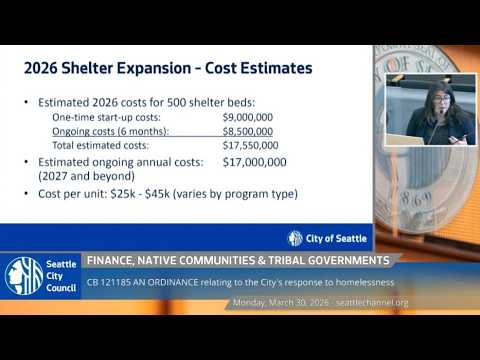
Council staff told a committee the mayor's leasing‑authority bill would let the FAS director sign leases up to 55,000 sq ft and remove a per‑square‑foot cap; staff estimated $17.5M one‑time to stand up the first 500 beds and $17M/yr ongoing, with per‑unit annual operating costs estimated at $25k–$45k depending on service model.
The Seattle City Council's Budget and Neighborhoods Committee reviewed two linked ordinances on April 1 intended to accelerate the city's shelter expansion: Council Bill 121184 would expand the Finance and Administrative Services (FAS) director's authority to execute leases for shelter purposes, and Council Bill 121185 would adjust the 2026 budget to provide early resources for the mayor's proposal.
Nicole Vallestero‑Soper, Director of Policy and Innovation in the Mayor's Office, said the leasing bill raises the square‑footage threshold from 18,000 to 55,000 square feet, removes a per‑square‑foot cap that would otherwise be indexed to a low inflation figure, and allows the city to select and prepare raw land so operators can stand up micro‑shelter programs faster. "This legislation allows the Finance and Administrative Services director greater flexibility in signing lease agreements related to shelter programs," she said, adding that the goal is to reduce typical site procurement timelines from up to nine months down to three to five months.
On the budget side, presenters told the committee the city's current estimate for standing up the first 500 shelter beds is about $17.5 million in one‑time costs and roughly $17 million per year in ongoing operating costs. Jon Grant, who answered detailed cost questions, said those estimates assume a mix of program models: fully staffed, high‑acuity programs can approach $45,000 per unit per year, while lower‑touch models could be nearer the $25,000 end; sites on public land reduce per‑unit costs because lease expenses are lower.
Central staff raised implementation concerns. Jennifer Labrecque, council staff, told members that passage would help accelerate shelter creation but that many details remain unsettled, including exact per‑site operating budgets, the level of services required at each site, and how the city will cover ongoing obligations over time. She cautioned against assuming passage would produce 500 units before the June 1 World Cup kickoff.
Councilmembers asked specific operational questions and previewed amendment concepts. Councilmember Rivera pressed staff about the assumptions behind the per‑unit cost range and whether existing tiny‑house villages would be required to change models; staff said the legislation does not change operational requirements at existing sites but would enable more rapid site procurement. Potential amendments circulated to committee members include a reporting requirement (executive report due Sept. 14, 2026), reserving at least one shelter for people in recovery, local residency prioritization for neighborhood shelters, buffer zones around shelters, and public‑safety/clean‑up plans.
Next procedural steps: Committee members noted amendment deadlines (ideas due the following day and final amendments due Thursday) and scheduled a committee vote for April 7. Staff emphasized that additional budget and operational details will be refined as contracts and site agreements are completed.