Get Full Government Meeting Transcripts, Videos, & Alerts Forever!
Get email alerts on the Shelter Expansion topic
No spam. Unsubscribe anytime.
Public commenters and providers urge council to fund and speed Seattle's shelter expansion
Summary
Dozens of providers, shelter residents and advocates told a council committee that an effective shelter expansion must include adequate staffing, behavioral‑health supports and funding to avoid short‑lived units; many speakers warned, "Without shelter, people die."
Dozens of providers, residents and shelter operators told the Seattle City Council's Budget and Neighborhoods Committee on April 1 they support the mayor's proposals to expand shelter capacity — but urged the council to fund higher‑support staffing, guarantee operational stability and coordinate with neighborhood mitigation plans.
The most common theme from the public comment period was urgency and an insistence that new shelter units be paired with sufficient wraparound services. "Without shelter, people die," said Miles Richardson of SHARE. Lisa, who identified herself as chair of the Downtown Seattle Streets to Housing Initiative and a long‑time real estate principal, said she supports the mayor's proposed shelter expansion and "its utilization of a model of evidence‑based, high‑support person‑centered sheltering," and called for funding that covers ongoing staffing and good‑neighbor agreements.
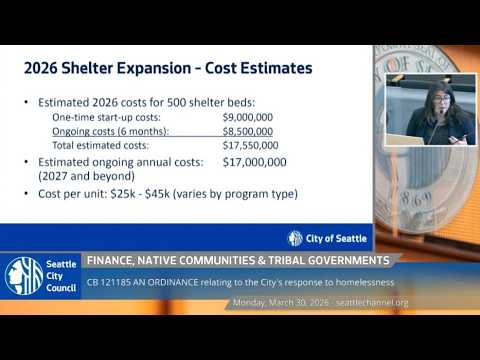
Why it matters: Councilmembers are reviewing two ordinances that would speed site procurement and allocate $4.9 million to launch the 2026 shelter expansion effort. Public speakers — including shelter operators such as SHARE and the Low Income Housing Institute, clinicians from Evergreen Treatment Services, and people with lived experience — told the committee that opening units rapidly without adequate staffing and behavioral‑health supports would fail many people and leave shelters underused.
Speakers described a range of models and specific needs. Sharon, executive director of the Low Income Housing Institute, said tiny‑house villages and RV safe‑parking have helped thousands: "Last year we housed 1,145 people in tiny houses in Seattle," she said, and urged both the lease‑authority bill and the budget allocation. Sam, Seattle‑King County director at ADA, and other providers stressed that some high‑acuity programs require substantially more than the baseline per‑unit estimates and urged the council to budget accordingly.
Residents and people who use shelters framed the expansion as lifesaving and rehabilitative. Corey Wilson said shelter programs helped him through a suicidal crisis: "Tent City Three, I say saved my life." Arming, who said he had been in recovery for a year while living in SHARE housing, described how stable shelter made treatment feasible.
Speakers also pushed for practical changes the committee is considering: granting the Finance and Administrative Services director authority to sign leases for larger parcels, reducing the time to prepare sites from many months to a few, and ensuring funding for staffing, neighborhood engagement and operations so shelters do not run out of funds before residents move into permanent housing.
Next steps: Committee members will continue hearings and are scheduled to consider amendments and vote on the package on April 7. The public testimony will inform upcoming amendment language and budget decisions.