Get Full Government Meeting Transcripts, Videos, & Alerts Forever!
Get email alerts on the Budget topic
No spam. Unsubscribe anytime.
Patchogue‑Medford reviews $29M budget proposal; athletics, textbooks and special‑education placements drive shifts
Summary
At Budget Workshop No. 2 the district presented roughly $29 million in budget lines for curriculum and instruction, outlining a districtwide 1.44% increase with notable increases in athletics, art curriculum purchases and pilot funding for a sixth‑grade science program, plus projected savings from reduced out‑of‑district special‑education tuition.
Patchogue‑Medford Union Free School District administrators presented the second budget workshop on curriculum and instruction, describing a package of line‑item changes that together total roughly just over $29 million and an aggregate 1.44% increase for the areas covered.
“We're looking at basically just over $29 million for all of these areas. And collectively, we're looking at a 1.44% increase,” said Mr. Maisie, who opened the workshop and led the presentation. The board scheduled a follow‑up workshop on March 30 and a public budget hearing on May 7.
The presentation highlighted several programmatic shifts:
- Athletics and safety: The athletics subtotal showed a roughly $129,000 (6.74%) increase, driven by equipment purchases (the presenter specified new treadmills for each secondary building and completion of a wellness‑center outfitting), a $12,000 rise in officials’ fees tied to contract pay increases, and a contractual increase (around $30,000) linked to a new RFP for a middle‑school athletic trainer and a more competitive model for the dance team.
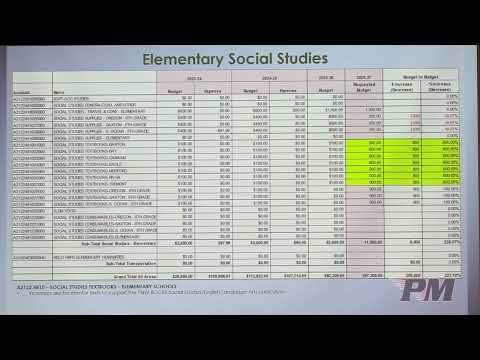
- Instructional materials and textbooks: Several departments moved toward online periodicals and digital texts, with textbook lines adjusted to hit state textbook aid thresholds. Elementary English lines increased to add phonics and decodable texts for primary students and to support dual‑language materials; secondary and other instructional areas showed a mix of reductions (for previously completed purchases such as graphing calculators) and targeted increases for curriculum and professional development.
- Sixth‑grade science pilot: Administrators described a one‑year pilot for a new sixth‑grade science program (presented as a trial this year). Staff said the pilot will be evaluated and, if selected for permanent adoption, will be brought to the board.
- Career & technical education and technology: CTE lines were adjusted to close out some legacy programs and support new programs such as fashion design merchandising; the technology education budget included a proposed $16,000‑ish request for additional drones to expand hands‑on student programming, but presenters flagged that procurement details may prompt adjustments at the next workshop.
- Pupil Personnel Services and special‑education placements: Pupil personnel services include increases for psychiatric evaluation services and a plan to improve in‑district medical access; presenters also projected a roughly $155,000 reduction on tuition costs tied to fewer students in private placements and bringing more students back into district programs, producing significant net savings in that area.
During public Q&A a resident pressed about the number and location of new treadmills and noted concerns that the district’s move toward digital materials could shift printing burdens onto families. Mr. Maisie responded that one new treadmill is planned for each secondary building, the district will pursue repairs for existing broken equipment where feasible and that the budget cannot absorb all replacement costs at once. On instructional materials the district said schools have printing capacity to provide paper copies for students who need them and will not require parents to print materials at home; a resident said, “it feels to me like we are moving away from paper‑based [materials], and maybe relying on the parents to print stuff out,” to which staff replied that schools can print needed copies.
Administrators also noted noninstructional changes: the ROC program’s growth added costs, some data‑processing lines increased (for projected color print volumes and a new copy contract), and adult‑education printing costs rose modestly.
Several line items contained caveats: the presenter repeatedly emphasized that some numbers are preliminary and will be refined (for example, the drone request, textbook allocations and professional‑development travel), and directors were asked to return with more detailed procurement and per‑pupil figures at upcoming meetings.
The board did not take final votes on budget adoption at the workshop; the presentation materials will be posted to the district website and the next budget workshop is set for March 30.