Get Full Government Meeting Transcripts, Videos, & Alerts Forever!
Get email alerts on the Economic Impact Kid Homes topic
No spam. Unsubscribe anytime.
SBCC executive committee delays April meeting, directs economic impact analyses and authorizes contracting for 'Kid Homes' code
Summary
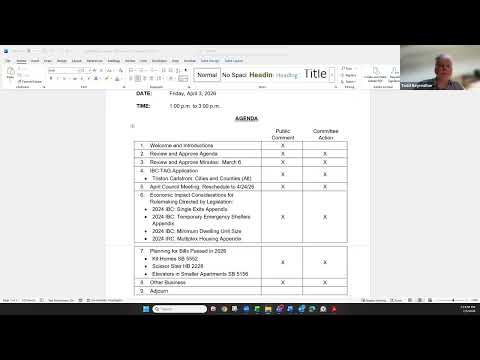
On April 3 the Building Code Council Executive Committee moved the April full council meeting to April 24 to allow more time for cost‑benefit analyses, directed the Economic Impact Workgroup to evaluate four legislatively mandated items, and authorized staff to begin contracting to develop baseline code language for the Kid Homes bill, which has a roughly one‑year rulemaking timeline.
The Washington State Building Code Council Executive Committee on April 3 voted to move its April Council meeting from April 17 to April 24 to allow staff more time to finish cost‑benefit and small‑business impact analyses and to prepare CR102 filings for pending rulemakings. Committee members also directed the Workgroup of Economic Impact to consider four legislatively mandated items in the upcoming analyses and authorized staff to initiate a contract to develop baseline code language for the Kid Homes bill.
Dustin Curb, the council’s managing director, told members that staff is still awaiting inputs — including Pacific Northwest National Laboratory data — needed to complete some economic work for the energy codes and other topics. Curb said extending the meeting date gives staff breathing room to finalize draft economic statements and CR102 materials. “We can still meet all the other deadlines, of getting publications out by the end of this year, and implementation on May 3rd next year,” he said.
Members debated whether statutory direction exempts rulemakings from a formal cost‑benefit analysis. Dierk Meierbachtol, who joined the meeting by phone, said his reading of the statute is that “perform rulemaking” was intended to mean completing rulemaking, not just starting it, heightening the sense of a fixed timeline for the Kid Homes item. Several members urged a pragmatic approach: require at least a concise economic assessment for the mandated items so policy choices are documented for the record.
The committee voted to direct the Economic Impact Workgroup to consider the four mandatory amendment topics (single exits, temporary emergency shelters, minimum dwelling unit size, and multiplex housing) as part of the group’s preliminary cost‑benefit and small business impact work. The motion was moved by Tom Handy and seconded by Jay Arnold and carried by voice vote.
Separately, members discussed the Kid Homes bill’s compressed schedule; staff and multiple members recommended hiring a consultant to draft baseline code language rather than relying solely on volunteer work. The body voted to direct staff to initiate contracting for a consultant to prepare baseline code language for the Kid Homes bill and to report progress at the April 24 Council meeting.
The moves aim to ensure staff and subject matter experts can produce documented economic analyses and to provide draft technical language to meet the statutory timeline for the Kid Homes rulemaking.