Get Full Government Meeting Transcripts, Videos, & Alerts Forever!
Get email alerts on the Veterans Legal Aid topic
No spam. Unsubscribe anytime.
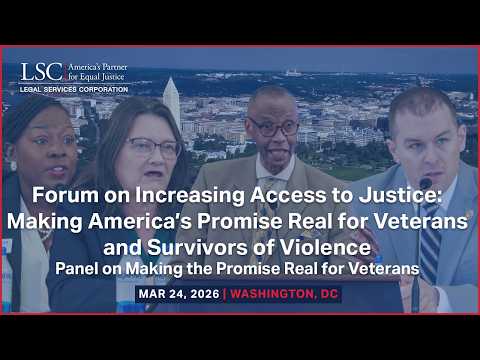
LSC panel: legal aid serves 44,000 veterans and must expand partnerships, panelists say
Summary
A Legal Services Corporation panel said civil legal aid is essential to preventing veteran homelessness and preserving benefits, reporting that LSC grantees served 44,000 veterans last year and urging expanded medical-legal partnerships, warm referrals and private-bar training.
A Legal Services Corporation panel on veterans’ civil legal needs heard firsthand how legal aid helps veterans preserve housing, retain benefits and correct administrative errors, and urged scaling partnerships between legal-aid organizations, the VA and private lawyers. John Malcolm, an LSC board member, said LSC grantees "served 44,000 veterans" last year with problems ranging from housing loss to income instability.
LSC General Counsel Will Gunn framed the conversation around efforts to end veterans’ homelessness, recalling a goal set by former VA Secretary Eric K. Shinseki and saying the VA’s Project Challenge survey repeatedly flags legal needs as a top shortfall. "Legal needs dominate the top 10 list of things that we, as Americans, are not doing well," Gunn said, explaining why access to civil legal help is central to the broader homelessness prevention effort.
The panel described three broad categories of veterans’ civil legal needs: VA benefits (including overpayment and garnishment disputes), discharge-status remedies such as upgrade petitions, and everyday civil matters like housing, family law, employment and record expungement. "The 2024 survey found that seven of the top 10 needs of homeless veterans were legal assistance," said Nick Hasenfus, a Marine Corps veteran and partner at Holland & Knight, who also cited LSC survey findings that 76% of low-income veteran households had at least one civil legal problem in a year and that 84% of those problems received inadequate or no legal help.
Panelists emphasized that timely, relationship-based outreach is as important as legal expertise. Pye Young, managing attorney at Bay Area Legal Services, described embedding legal advocates at VA medical centers and building ties with social workers and clinicians so referrals are "warm" rather than paper-based. Laura Tuggle, executive director of Southeast Louisiana Legal Services, said her program rebranded its homeless-focused unit as the Veterans and Innovative Projects (VIP) Unit to reduce stigma and increase engagement, and reported a roughly 750% increase in veterans seeking services after recent disasters in Louisiana.
The panel also urged practical steps to expand capacity: use clinics and pro bono partnerships to match private and in-house lawyers to appropriate cases; provide training and mentorship so volunteers do not "get over their skis" in unfamiliar practice areas; and design services that remove access barriers such as inconvenient locations or lack of trust. Hasenfus highlighted the private bar's ability to contribute time-consuming, high-impact legal work and policy efforts, noting Holland & Knight’s reported pro bono contribution of more than 51,500 hours valued at over $35.8 million.
Panelists closed with client stories that illustrated the stakes: attorneys helped one 70-year-old veteran avoid a $52,000 VA garnishment that would have threatened his housing and Social Security, and assisted another client victimized by identity theft to keep benefits and avert further administrative consequences. The panel said next steps include expanding medical-legal partnerships, training VA and community partners on referrals, and continuing outreach targeted to women veterans and other underserved groups.
The event concluded with thanks to the panelists; no formal resolutions or votes were taken.