Get Full Government Meeting Transcripts, Videos, & Alerts Forever!
Get email alerts on the Waste Transfer Station topic
No spam. Unsubscribe anytime.
Residents and health advocates press Evanston to address Waste Transfer Station impacts near high school
Summary
Residents, health professionals and an Evanston environmental-justice coalition told the APW committee the Waste Transfer Station (WTS) at 1107 Church has produced years of odors, noise, vibrations and health concerns; staff said state permits limit city regulation but pledged more transparency on inspections and tonnage reporting.
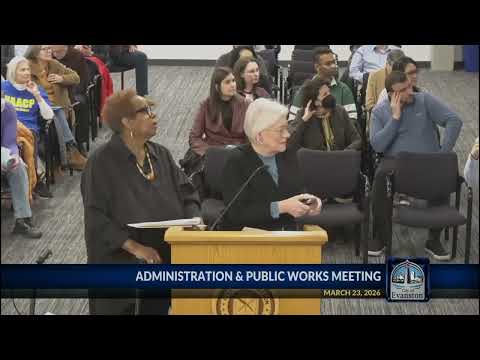
More than a dozen residents, community organizers and health professionals urged the APW committee on March 23 to press for stronger mitigation and transparency around the Waste Transfer Station at 1107 Church in Evanston.
At the committee meeting, presenters from the Evanston Environmental Justice Coalition outlined the WTS history and ownership changes dating to the original 1983 approval and a 1984 Illinois EPA permit. "The city did not impose any health and safety protections despite being in a Black residential neighborhood," presenter Janet Alexander Davis said, summarizing the coalition's three goals: document history, outline ongoing community impacts, and present resident testimonials.
Why it matters: Presenters and commenters said the facility sits near a historically Black neighborhood and within walking distance of Evanston Township High School, and they tied the WTS to long-term quality-of-life and health burdens. Dr. Marie Kabia, an obstetrician-gynecologist and pediatric environmental-health affiliate, noted the city has reported "a 13-year difference in life expectancy between Evanston residents" in different areas and urged action to address factors that may contribute to that disparity.
What community members described: Multiple residents described persistent strong odors, masking chemicals sprayed at the facility, noise and vibrations from nightly tipping and container-handling, bright floodlights at night, and heavy truck traffic. Jordan McClure, a second-ward resident, said he can "feel the vibrations" and asked what chemicals are used to mask odors and how residents can access material data safety sheets. Church Street Village residents told the committee the misting agents have caused or intensified chemical sensitivities for some neighbors.
What staff and counsel said: City Engineer Laura Biggs summarized the 2016 host-community settlement (an initial financial settlement of roughly $1.2 million plus ongoing tonnage fees), explained that the original agreement allowed continued WTS operation at the site until it permanently ceases use or is certified closed by the Illinois EPA, and reviewed how host fees have been spent (alley and sidewalk projects, with roughly $42,000 remaining in the capital-improvement fund). Health and Human Services director Ike Oko said Cook County's Office of Sustainability and Environment inspects the facility about five to six times a year under delegated authority from the Illinois EPA, while the city conducts complaint-driven inspections.
On legal limits: Corporation Counsel Alex Ruggie told the committee the state regulates and permits the transfer station and that past attempts by the city to impose additional regulation prompted litigation and a settlement. Ruggie said the city retains nuisance and noise-enforcement tools but cannot unilaterally alter state permitting terms without risking litigation.
Asked options: Council Member Harris pressed staff to post inspection reports and tonnage records publicly, to clarify how Cook County validates tonnage, and to explore legal pathways such as caps on truck trips or a reasonable phased prohibition of the site as a long-term option. Staff said they would research those proposals and work with the community on more transparent data-sharing and additional monitoring.
Numbers and funds: Presenters said tipping fees were amended in the 2016 agreement from $2 per ton to $0.75 per ton with modest escalators (to a maximum of $1 per ton across 20 years). The city reported the initial settlement plus subsequent fees total approximately $1.9–2.0 million and that the 2019 air-quality monitoring project funded from the impact zone was judged inconclusive.
Requests the coalition made: improved and frequent air-quality monitoring, public access to inspection and tonnage reports, disclosure of chemicals used as odor-masking agents and their material-safety-data sheets, a count or cap of daily truck trips, and a community-driven plan for future use of the site and spending of host-community funds.
What happens next: Council members requested follow-up: post Cook County inspection and tonnage reports online, schedule community briefings, investigate whether truck-trip caps or a phased prohibition are legally feasible, and examine whether additional multi-year air monitoring should be funded. No formal regulatory change to the WTS permit occurred at the meeting; staff said they would return with more information.
Quotes: "Living within a thousand feet of a waste transfer station is harmful to public health and well-being," a presenter said, referencing the 1987 Illinois setback policy cited during the presentation. Corporation Counsel Alex Ruggie said city regulation is limited because the state issues and enforces the operating permit, and urged complaint reporting so city nuisance enforcement can act when appropriate.
The committee did not adopt any immediate ordinance or new permit condition; instead members directed staff to provide clearer public access to inspection and tonnage data, explore enforcement options and legal feasibility of caps or a phase-out, and hold further community meetings.