Get Full Government Meeting Transcripts, Videos, & Alerts Forever!
Get email alerts on the Housing Policy topic
No spam. Unsubscribe anytime.
Regional planners outline how Public Act 25‑1 will change local zoning, parking and housing plans
Summary
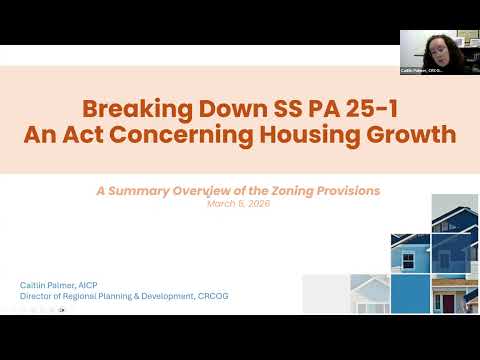
CROG staff briefed the Prague Regional Planning Commission on Connecticut’s Public Act 25‑1, summarizing immediate and upcoming changes to zoning (summary review, middle housing), parking rules, optional zones (PHDZ, TOC), timelines for housing growth plans, and state funding programs; staff urged municipalities to begin regulatory updates ahead of July 1 and 2027/2028 deadlines.
Caitlyn Palmer, director of regional planning and development at CROG, told the Prague Regional Planning Commission that Public Act 25‑1 (the housing growth act) contains a mix of immediate and phased changes that will require municipalities to update zoning regulations and plan documents.
Palmer framed the briefing as informational and not legal advice, saying, "I am not a lawyer," and asked towns to consult local counsel on implementation. She highlighted that the act has 53 sections and that CROG would summarize roughly 15–20 of the most land‑use relevant provisions.
The presentation singled out three FYI items: section 48 authorizes the state Department of Housing to act as a developer on state‑owned land (sell, lease, manage units); section 33 directs OPM to deliver a statewide wastewater capacity study by July 1; and section 42 commissions a study of the 830G affordable‑housing threshold. "OPM is sort of seeing this study as an iterative process," Palmer said of the wastewater work.
Among the early actions already effective, Palmer noted that section 24 raises the thresholds for landowner protest petitions and makes it easier for commissions to overturn successful petitions (reducing the vote needed to overrule a petition from two‑thirds to a simple majority). She also summarized section 26, which bans "hostile architecture" on municipal property and requires removal of such features if a complaint is received.
Palmer described new optional programs: Priority Housing Development Zones (PHDZs, sections 8–10) allow municipalities to apply to the Department of Housing for a designation that requires permitting multifamily housing (three or more units) as‑of‑right and can earn HU points toward 830G moratoria relief. Transit‑Oriented Communities (TOCs, sections 11–12) are opt‑in designations for municipalities with qualifying transit service that unlock additional funding and require adoption of transit‑oriented district zoning.
She explained accessory dwelling unit (ADU) rules tied to TOD/TOC districts (section 13) and a July effective change that treats mobile/manufactured homes more like single‑family housing by removing an older 22‑foot width reference.
A central implementation change is the requirement to allow transit‑community "middle housing" (buildings of two–nine units such as duplexes, triplexes and cottage clusters) and mixed‑use development on commercial and mixed‑use lots subject to summary review (a non‑discretionary approval process without a public hearing). Palmer said summary review is distinct from as‑of‑right and "it explicitly prohibits discretionary zoning actions or public hearings"; she cautioned municipalities to be prescriptive in zoning standards so summary review remains non‑discretionary.
On parking, the act generally prohibits municipal minimum parking requirements for residential development, with limited exceptions: municipalities may require parking minima for developments of 17 or more units but must accept a developer‑submitted parking needs assessment; smaller developments may be regulated only within designated conservation and traffic mitigation districts. Fee‑in‑lieu of parking remains possible but the statute does not fix a per‑space dollar amount; municipalities must adopt a local fee schedule.
Palmer stressed timing: many zoning changes take effect July 1 and CROG region housing growth plans are due June 1, 2028. OPM will provide 10‑year regional housing growth targets by the end of the year; CROG will develop recommended local affordable housing goals by June 2027 and municipalities must choose whether to opt into the regional plan or prepare municipal plans.
Commissioners asked implementation questions. When asked whether establishing PHDZs or TOCs requires simultaneously updating a town’s plan of conservation and development (POCD), Palmer said best practice is to align the POCD but municipalities may not need to update them simultaneously. On who decides whether a project "substantially" impacts public health and safety under summary review (staff or commission), Palmer said the statute is vague and that CROG and other COGs are commissioning guidance to define reasonable parameters: "I don't have a good answer for you," she said, and pledged to follow up with more concrete recommendations.
Palmer said CROG will share slides, the recording and a summary document with deeper detail for each statute section. She also noted CROG has limited brownfield remediation loan funds (roughly $500,000 available on a rolling basis) for remediation loans to developers.
The presentation concluded with CROG staff offering workshop support and technical assistance on middle housing and summary review drafting. Palmer emphasized municipalities should begin regulatory housekeeping now to be ready for July 1 effective dates and the 2027–2028 planning timeline.
Ending: CROG will circulate materials, links and model language as guidance becomes available and said more webinars and targeted workshops are planned to help towns implement the act.