Get Full Government Meeting Transcripts, Videos, & Alerts Forever!
Get email alerts on the Workplan Overview topic
No spam. Unsubscribe anytime.
Encinitas council refines FY 2026–27 work plan, asks staff for SMART objectives and budget estimates
Summary
The Encinitas City Council reviewed a draft FY 2026–27 work plan, asked staff to return with SMART quarterly objectives in May, and requested cost estimates for items including red-light cameras, fire station funding and habitat stewardship additions.
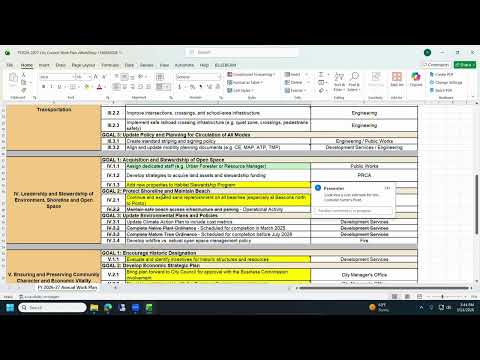
The Encinitas City Council met in a special session to review and refine its draft FY 2026–27 annual work plan, with staff and council members agreeing to return the document in May with specific, measurable quarterly objectives. Deputy City Manager James said the draft is a working document developed from a February workshop and noted spreadsheet markers that indicate likely funding needs and items staff recommends treating as operational rather than council-level goals.
Public comment was brief. Vivian Vale asked the council to include a short-term vacation rental (STVR) program cleanup in the work plan. Lee Ratcliffe, a founding member of Safe Streets, thanked the council for including traffic-safety items and offered the group’s technical expertise on enforcement and engineering.
Council members spent most of the meeting suggesting edits and clarifications rather than approving new policy. Several members asked staff to consolidate and map existing master plans so the city can align long-range infrastructure and land-use decisions. Council Member Lines urged the council to add a long-term funding strategy for Fire Station 1 and Fire Station 6 into focus-area one, saying that the decision likely depends on the city’s five-year capital plan and borrowing capacity. Deputy City Manager James said the intent of the “consolidated master plan” goal is to assess and align existing plans rather than rewrite them.
Traffic safety repeatedly surfaced in the discussion. Council members asked staff to analyze the budget implications of enforcement and infrastructure options — including a red-light camera cost analysis — and to return cost estimates during the budget workshop cycle. James told the council staff recommends maintaining an unrestricted reserve (the draft suggests $500,000) for contingencies and budgeting needs.
Council members also requested: feasibility work before increasing mandatory inclusionary housing percentages (members noted prior studies and cited typical ranges of 15–20% as context), cost estimates to add Surfers Point to the habitat stewardship program, and more explicit objectives for permit-process cleanup (including STVRs), pavement-management work, and Leucadia flood/drainage projects.
City staff said they will translate the council’s edits into SMART objectives, mark items requiring funding, and return a revised work plan with objectives and carryovers in May for further council review. No formal motions or votes were taken at the special meeting.