Get Full Government Meeting Transcripts, Videos, & Alerts Forever!
Get email alerts on the Property Tax topic
No spam. Unsubscribe anytime.
Concord task force divided on residential tax exemption; urges options, phased approach
Summary
At its March 26 meeting the Tax Relief Evaluation Task Force reviewed a near-final report, debated whether to keep the town's residential tax exemption (RTE) and agreed to present the Select Board with several replacement or mitigation options — including a phased transition and dollar-level analyses — before a final vote.
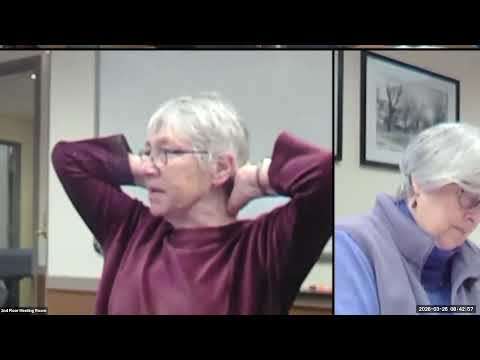
At a March 26 meeting, the Concord Tax Relief Evaluation Task Force reviewed a near-final draft of its report and spent the bulk of the session debating whether the town's residential tax exemption (RTE) should be retained, altered or eliminated. Members agreed they would not recommend unilateral action without laying out replacement options and a transition plan for the Select Board.
The group said the draft report will be finalized for circulation to Meredith and the Select Board by the April 2 meeting, but members asked for additional analyses before any formal vote. Rich asked the staff to produce a dollar-level efficiency analysis showing how much of the RTE's benefit goes to households above and below $150,000 in income; he noted the current efficiency calculation shows "48% of the tax reduction goes to people with incomes above 150k." (Rich)
Task force members repeatedly flagged two headline numbers for the report: an 89% estimate that 3,476 of 3,906 qualifying residential properties are below the break-even point, and a complementary 11% share of the $3.22 million property-tax shift borne by qualifying homeowners above the break-even point. Members said those figures should be highlighted in the executive summary and clarified in accompanying charts.
On policy alternatives, members sketched several options to present to the Select Board rather than issuing a single up-or-down recommendation. Possibilities discussed included raising the senior means-tested exemption (SMTE) asset cap (one speaker suggested a $500,000 cap), adopting a circuit-breaker style program commonly called "41C and a half" (the committee discussed a 5% to 10% exemption for seniors, with questions about the multi-step adoption process), repurposing or targeting the Hugh Cargill Trust to help non-senior low-income residents, and piloting other targeted relief efforts. Several members favored a phased approach that would keep the RTE in place until replacement measures were on track.
Members also raised data issues. The survey underpinning parts of the analysis under-represents renters and over-represents seniors, the task force said, and the rental-response sample (43 responses) is too small to produce reliable renter-income estimates. The committee asked staff to produce two types of analysis: unit counts and a dollar-shift breakdown showing how tax dollars flow across income groups, because unit and dollar measures tell different policy stories.
Select Board members and liaisons who joined the meeting said a helpful deliverable would be a short set of options with pros and cons, numeric impacts, and a few enclosed "real-person" profiles showing how the options would affect representative households. Paul, who identified himself in the meeting as a Select Board member, said such practical examples would help elected officials evaluate trade-offs. (Paul)
Scott, a meeting participant, urged transparency about how the task force will report its views: he recommended including any formal vote results (even if split) so the Select Board understands where members agreed and disagreed. (Scott)
No formal vote on the RTE occurred at this meeting. The task force set a near-term timeline: sanitize chapter five numbers, produce slide materials for the Select Board, circulate Ellen's dollar analysis and Rich's supplemental numbers within the next 48 hours, and reconvene next week with a short slate of options that could be presented — and possibly voted on — at a subsequent meeting. The committee adjourned after approving the meeting minutes and completing its review session.
The task force emphasized it intends to present the Select Board with options that balance efficiency (targeting those most in need) and equity (mitigating harms to seniors and other vulnerable homeowners) and to avoid a sudden policy change that would leave low-income residents worse off during a multi-year transition to a replacement program.