Get Full Government Meeting Transcripts, Videos, & Alerts Forever!
Get email alerts on the Universal Pre K topic
No spam. Unsubscribe anytime.
Board questions feasibility of governor’s UPK proposal as district cites space and cost limits
Summary
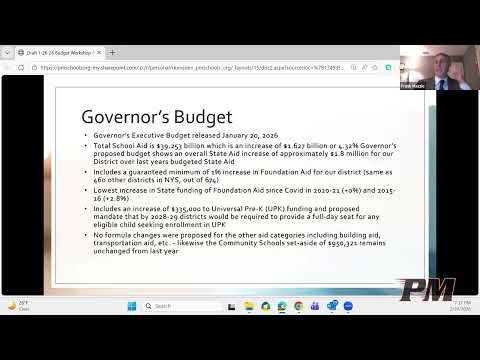
Board members and staff debated the governor’s proposed universal pre-K funding and mandate to offer full‑day seats by 2028–29, saying the $10,000 per‑student proposal and a draft $335,000 UPK line may not cover provider costs or local space constraints.
Board members asked detailed questions about the governor’s proposed universal pre‑K (UPK) funding and whether the district could meet a potential mandate requiring full‑day seats by the 2028–29 school year. A board member said they had heard the governor “is giving us $10,000 … for preK and for universal preK,” and asked whether the district would be bound to provide seats even if space was limited.
District staff cautioned that the proposal discussed in Albany remains a draft and that many details could change. Mr. Maisie said the draft included a state-aid line the presentation estimated at about $335,000 for the district, but he noted the proposal is only a proposal and “there’s a lot more that has to come out of this.” He added that the requirement to offer seats to any eligible, interested child would create capacity pressures and that districts can either provide UPK in‑house or contract with community-based providers.
Board members raised a second concern: even where the state provides additional per‑student funding, the rate community providers charge can rise. One speaker said increased provider rates can offset the additional state funding such that “you’re getting more money, but it’s costing you more money.” District staff agreed, saying current UPK funding does not cover the full cost of every child wanting a seat and that contracting options often require the district to provide space for the provider.
What the district says about current capacity: staff said the district currently houses about 270 in‑house UPK students, while a cohort moving into kindergarten could be about 530–550 students, raising questions about how many additional seats would be required if UPK expanded to all eligible children. Staff also noted transportation is not currently required for UPK unless a child’s Individualized Education Program (IEP) specifies it.
No formal action or commitment to expand UPK was made at the workshop; administrators said the proposal will require further analysis as the state budget process and legislative language are finalized.