Get Full Government Meeting Transcripts, Videos, & Alerts Forever!
Get email alerts on the Utility Affordability topic
No spam. Unsubscribe anytime.
Baltimore City Council hears residents’ testimony on soaring BGE bills as utility declines to attend
Summary
Residents, union leaders and consumer advocates told the City Council that Baltimore Gas and Electric’s multi‑year rate plans and contractor practices have driven up delivery charges, produced record profits and left many customers unable to pay; council members urged the Public Service Commission and state lawmakers to act.
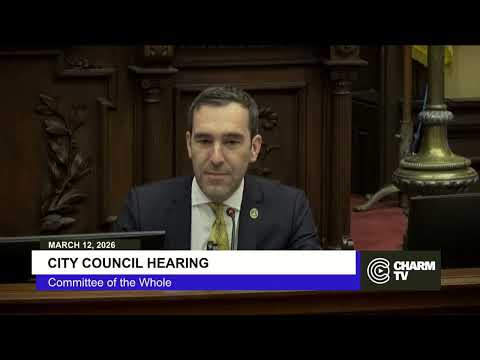
Baltimore City Council President Cohen opened a Committee of the Whole hearing on L26‑0043 saying Baltimore residents are choosing between paying their BGE bills and basic needs, and that BGE’s absence at the hearing was notable: “BGE doesn’t have enough respect for the people that pay their bills to show up tonight,” he said.
Consumer advocate David Lap of the organization introduced in the record as "Maryland's People's Council, David Lap," told the council that distribution or delivery charges — the portion of a bill BGE controls — have risen sharply since Exelon’s acquisition of BGE in 2012 and now make up a substantially larger share of typical bills. He described multi‑year rate plans and forecasted test years as mechanisms that shift risk to ratepayers and permit utilities to recover projected spending before projects are completed.
“I’m hopeful that the legislation” limiting forecasted test years will force a higher standard for customer benefits, Lap said, referring to a speaker‑authored bill identified in the hearing as HB1532.
Multiple residents gave brief testimony about personal impacts. Frederick Denverville said his household’s gas charges rose from about $104 a month to as much as $500, and that he has taken loans to pay utility debt. A number of speakers said the Public Service Commission has opened an investigation into BGE’s gas safety inspection program and that customers have reported difficulty reaching BGE’s call center.
Council members pressed witnesses on remedies. Councilman Glover noted that BGE’s customer assistance totals — described in the hearing as about $15 million in 2025 and $2.5 million so far this year — fall far short of need given the scale of distribution rate increases. Council members repeatedly called on state regulators and the General Assembly to tighten statutory language and give the PSC clearer authority to prevent utilities from recovering costs that do not demonstrably benefit customers.
Several public commenters and advocates urged the council to consider public power as a structural alternative to investor‑owned utilities, saying a municipally controlled utility could offer lower rates and local accountability.
The council did not take a vote at the hearing; President Cohen said the body will continue its advocacy in Annapolis and encourage residents to press the PSC and state lawmakers to adopt measures (including HB1532) to curb what they described as excessive rate recovery practices. The committee adjourned after an extended public comment period.