Get Full Government Meeting Transcripts, Videos, & Alerts Forever!
Get email alerts on the Environmental Law topic
No spam. Unsubscribe anytime.
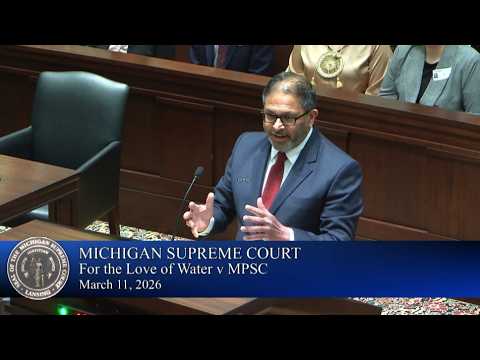
Michigan Supreme Court hears arguments over Line 5 tunnel, agency duty under MEPA and the public trust
Summary
At oral argument in For the Love of Water v. MPSC, advocates, the Michigan Public Service Commission and Enbridge debated whether MEPA and the public-trust doctrine require a separate, detailed public‑trust determination before the Line 5 tunnel project proceeds and whether the MPSC’s 350‑page order satisfied that duty.
The Michigan Supreme Court on oral argument Tuesday heard competing views over whether the Michigan Environmental Protection Act (MEPA) and the public‑trust doctrine require a separate, rigorous public‑trust finding before the state’s utility regulator’s approval of Enbridge’s Line 5 tunnel project can stand.
Ria Kangji, arguing for petitioner For the Love of Water, told the court the choice between building a tunnel and leaving the dual Line 5 pipelines in place is a false dichotomy and urged the justices to treat public‑trust concerns as a threshold matter. “If the tunnel is authorized without appropriate consideration for public trust concerns, we could very well be handing to the next generation another environmental catastrophe,” Kangji said, arguing that the commission’s impairment finding was cursory and that the Great Lakes Submerged Lands Act assigns primary public‑trust determinations to Eagle.
The MPSC, represented by Daniel Sonelt, told the court the commission complied with MEPA (citing section 17052/1705 in briefs) and that its nearly 350‑page final order considered environmental impacts and alternatives, so no separate common‑law public‑trust analysis is required. Sonelt said the commission treated public‑trust issues as part of its MEPA alternatives analysis and asked the court to affirm the court of appeals decision.
John Burch, counsel for Enbridge, argued that state and federal permitting processes — including a pending Eagle review and a recently completed Army Corps of Engineers environmental impact statement — will address public‑trust and environmental risks, and that delaying approval would prolong the period the existing underwater pipelines remain in service. Burch warned of near‑term consequences if Line 5 were shut down, saying fuel delivery disruptions could affect airports and heating fuel supplies across Michigan.
Justices repeatedly probed how MEPA’s environmental impact analysis differs from a public‑trust inquiry and whether statutes that touch the same subject (MEPA and the Great Lakes Submerged Lands Act) must be read together to identify which agency has the primary responsibility. Counsel disagreed about consequences: Kangji said that under Eagle’s Rule 1015 a finding of more‑than‑minimal impairment would end the analysis; Burch countered that the common law and statute require an alternatives analysis and stressed the tunnel’s long‑term benefits.
The parties also debated evidentiary gaps. Kangji pointed to testimony in the record (for example, testimony from Kevin Donner, Little Traverse Bay fisheries manager) that tunnel construction could destroy spawning grounds for whitefish and lake trout, and said the MPSC did not obtain a geotechnical baseline report from Enbridge — a document Eagle has requested and that Kangji described as central to assessing construction risk. Burch responded that the Army Corps’ EIS and the state permitting process would consider such risks.
No vote or ruling followed; counsel completed rebuttal and the case was submitted to the court. The justices’ questions focused on statutory interpretation (how MEPA and the GLSLA interact), the scope of the MPSC’s fact‑finding in its order, and whether a court decision should require a specific agency process before any construction authorization becomes final.
The court’s decision will determine whether the MPSC’s order stands as final or whether the matter must return for a separate, detailed public‑trust review by the agency the petitioners say has primary jurisdiction.