Get Full Government Meeting Transcripts, Videos, & Alerts Forever!
Get email alerts on the Human Resources Budget topic
No spam. Unsubscribe anytime.
Budget committee reviews DHR’s FY27 request as members press on hazard-pay grievances and AI tools
Summary
The committee heard the Department of Human Resources’ $9.54M FY27 operating request, questioned corrections for temporary hazard-pay misclassifications and sought measurable timelines for a NEOGOV recruitment module and an AI-based classification pilot.
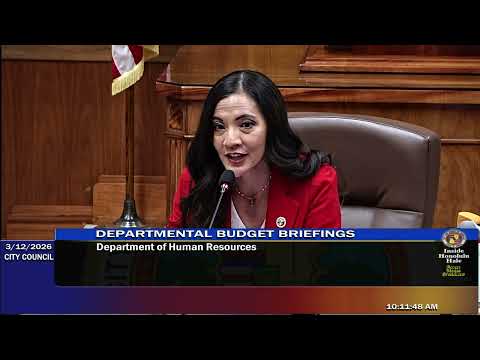
The Honolulu City Council Budget Committee on March 12 reviewed the Department of Human Resources’ (DHR) proposed fiscal year 2027 operating budget and pressed officials about unresolved temporary hazard-pay complaints and how quickly new recruitment and classification technologies will produce results. Director Nolan Miyasaki presented a $9,544,967 request funded entirely from general funds and said roughly 90% of the budget is salaries.
Why it matters: Council members said the hazard-pay misclassification complaints affect worker fairness and morale and asked what administrative recourse employees have when they believe they were misclassified or inadequately represented. Lawmakers also emphasized that procurement of recruitment and AI tools should produce measurable hiring and reclassification outcomes.
Director Nolan Miyasaki told the committee DHR’s FY27 package includes a NEOGOV “Attract” subscription to broaden candidate outreach, an AI classification subscription to speed class-spec updates, and a one-time pay equity study. "We're going to continue to research these cases on a case-by-case basis," Miyasaki said regarding temporary hazard-pay issues, adding, "we will definitely get this resolved," though he declined to commit to a seven-day closure timeline referenced by council members.
Council Member Kia pressed DHR for clarity after learning the department had received up to about 44 complaints in one department regarding temporary hazard pay and telework/classification status. Kia asked whether the grievance process would apply; DHR labor staff explained the formal grievance route applies to alleged violations of the collective bargaining agreement (CBA). "If an employee wanted to file a grievance, they would need to identify a provision in the CBA that they believe was violated," the labor chief said, noting other remedies (equal-opportunity claims, administrative complaints) may apply depending on the facts.
On the AI and recruitment tools, DHR said it is piloting vendor sessions this week and is cost-sharing early implementation with a participating department for FY26 due to funding timing. Director Miyasaki described bulk-update capabilities—such as rapidly locating and changing driver-license requirements across position descriptions—and said the platform can speed otherwise manual work. Council Member Dos Santos Tam asked whether DHR can show a concrete output (for example, a target number of rewritten position descriptions by Sept. 30). Miyasaki said DHR does not have a specific figure today and will follow up with division-level metrics.
The committee also asked about vacancies and overtime: DHR reported seven vacancies (six expected filled by July 1) and an overtime allocation of roughly 1,389 hours (~$37,000) for large-scale testing events.
What’s next: Committee members asked DHR to provide follow-up metrics on the AI pilot and clear guidance to employees about grievance and administrative routes for hazard-pay disputes. DHR said it will continue case reviews and report back to the council.
Sources: Presentation and Q&A with Director Nolan Miyasaki, Department of Human Resources (testimony and answers during the March 12 Budget Committee meeting).