Get Full Government Meeting Transcripts, Videos, & Alerts Forever!
Get email alerts on the Wildlife Management Deer Population topic
No spam. Unsubscribe anytime.
State wildlife biologist urges town to ban feeding and pursue coordinated deer management
Summary
At a town meeting, Brian Jones of the New Jersey Department of Environmental Protection told residents that rising local deer numbers are linked to more vehicle collisions and higher tick prevalence, urged residents to stop feeding deer, and recommended coordinated, spatially targeted management with neighboring municipalities and DEP support.
Brian Jones, a deer biologist with the New Jersey Department of Environmental Protection, told residents at a town council meeting that the community’s rising deer numbers are producing measurable harms — from vehicle collisions to greater tick abundance — and urged a mix of local rules and coordinated management to reduce risks.
"Stop feeding them. They do not need your help," Jones said, adding that feeding can raise reproduction and habituation and put both deer and people at risk. He recounted local instances in which habituated deer approached people and at least one incident in which an elderly resident was injured.
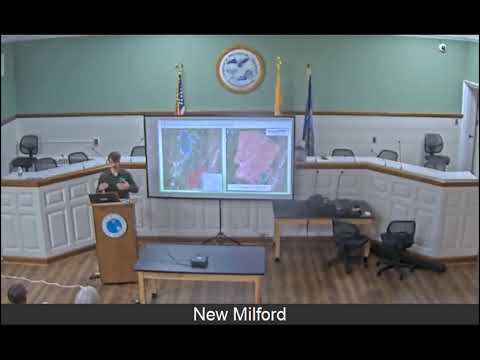
Jones framed the issue around three impact categories: human health (chiefly deer‑vehicle collisions), tickborne disease risk, and ecosystem changes. He said deer are unevenly distributed across towns and neighborhoods, and that mitigation tools work differently depending on local deer density. ‘‘If you’re living in this red area, you’re experiencing about 121 deer per square mile; averaged across the township it’s about 29 per square mile,’’ he said as an example of how impacts vary within municipalities.
On mitigation, Jones reviewed nonlethal options that homeowners and towns can deploy: eight‑foot or tightly spaced fencing and tree tubes to prevent buck rub, and chemical repellents for gardens. He cautioned that repellents require frequent reapplication and are not 100 percent effective at high deer densities. He also noted that local ordinances — for example those that restrict certain fencing types — will affect what residents can do.
Jones addressed disease concerns, explaining that blacklegged ticks (deer ticks) correlate with deer abundance and that mice remain the principal reservoir for Borrelia burgdorferi, the bacterium that causes Lyme disease. He advised standard CDC precautions: treat clothing with permethrin where appropriate, check yourself and pets after spending time in vegetation, and consult licensed pest‑control firms for treatment options.
On chronic wasting disease (CWD), Jones said the prion disease affects cervids elsewhere in the Northeast but is not currently known to be present in New Jersey. He described the disease’s severity in other species and said cross‑species transmission to humans is considered extremely unlikely based on current evidence.
When residents asked whether the town should pursue active population reduction, Jones said management decisions are local and depend on residents’ tolerance levels. He said lethal management remains the primary tool in many places and that fertility control has high costs and limited effectiveness where immigration of deer from neighboring areas occurs. As examples he cited statewide harvest figures (roughly 39,000 deer harvested annually) and noted that Bergen County’s harvest is far lower (about 179 last year), leaving most suburban areas with limited hunting access.
Jones urged municipal cooperation for population‑level solutions. He described multi‑town cooperatives that received grant funding from the DEP for population surveys and said the agency can provide consultation, share examples from neighboring towns, and deliver management and education presentations. He recommended local measures the town can start immediately: public education about not feeding deer, targeted surveys (including inexpensive drone mapping), and discussions with nearby municipalities about joint programs.
Council members said they would consider education campaigns and possible ordinances restricting deer feeding. The DEP representative offered to share slides and product lists from the presentation and to return for further briefings and technical assistance.
"We’ll provide as much consultation as we possibly can," Jones said. "We’ll tell you what works and what doesn’t, and we can come back and help run the public conversation."