Get Full Government Meeting Transcripts, Videos, & Alerts Forever!
Get email alerts on the Veterans topic
No spam. Unsubscribe anytime.
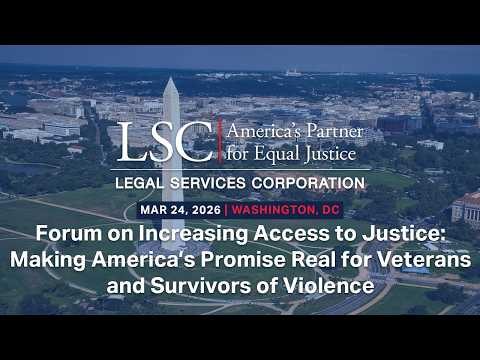
LSC forum highlights gaps and innovations in legal aid for veterans
Summary
At a Legal Services Corporation forum, experts said veterans face persistent legal barriers—VA benefits disputes, discharge upgrades, housing and consumer issues—and promoted medical-legal partnerships, warm referrals, and pro bono clinics as ways to expand capacity.
A Legal Services Corporation forum panel on veterans’ legal needs on Thursday brought operators, pro bono lawyers and program leaders together to map persistent gaps and scalable solutions.
Will Gunn, LSC general counsel and an Air Force veteran, framed the problem by recalling VA efforts to end veterans’ homelessness and the persistent shortfall of legal help for veterans: without counsel, veterans’ benefits, housing and family-law problems often cascade into homelessness and financial instability. “I would much rather be guilty of going after a bridge too far than not doing everything in my power to end this national stain,” Gunn said, describing the urgency driving the work.
Panelists described three broad clusters of legal need. Nick Hasenfus, a Marine Corps veteran and partner at Holland & Knight, said veterans commonly need help with VA benefits (including overpayment disputes), discharge-upgrade petitions that can restore access to benefits, and everyday civil matters such as eviction, custody and expungement. He cited surveys showing high rates of legal problems among low-income veteran households and that many problems go unaddressed.
Laura Tuggle, executive director of Southeast Louisiana Legal Services, described her program’s veteran-focused work, noting that 36% of Louisiana veterans meet the United Way’s ALICE definition (asset-limited, income-constrained, employed). Tuggle said the program saw a steep surge in demand after recent disasters—“a 750% increase in veterans seeking our services”—and emphasized taking services to veterans by embedding attorneys in VA sites and community locations.
Bay Area Legal Services’ Pye Young outlined the medical-legal partnership model used at Bay Pines VA, where legal advocates are embedded with clinical teams and social workers to enable warm referrals. “If we give a client a piece of paper versus your social worker calling our advocate and saying, ‘I have a client here,’ that warm referral bridges the gap,” Young said, describing expansion from one clinic to seven across a five-county area.
Private-law participation and training were also highlighted. Hasenfus described how big firms can provide time-intensive legal resources and mentorship but often need training to help with areas such as expungement or consumer matters; Holland & Knight reported thousands of pro bono hours supporting veterans work.
Panelists closed with client vignettes illustrating outcomes: a veteran whose VA benefits and housing were preserved after representation in an overpayment matter; intervention that averted an eviction tied to mobile-home repairs; and long-term housing assistance that enabled a former tenant to buy a home.
The panelists urged policymakers and funders to expand investment in legal aid, strengthen partnerships with the VA and health providers, and scale models—medical-legal partnerships, warm referrals and targeted pro bono clinics—that increase veterans’ access to counsel.