Get Full Government Meeting Transcripts, Videos, & Alerts Forever!
Get email alerts on the Procurement topic
No spam. Unsubscribe anytime.
Riviera Beach council debates raising procurement thresholds and new vendor rules; staff to return with reporting plan
Summary
Procurement Director Latana Ammons proposed modernizing Chapter 16.5 with new definitions, a purchase‑order requirement, higher solicitation thresholds, protest bond rules and a local vendor preference. Councilmembers sought monthly reporting, limits on manager signing authority and proof of vendor data before raising thresholds.
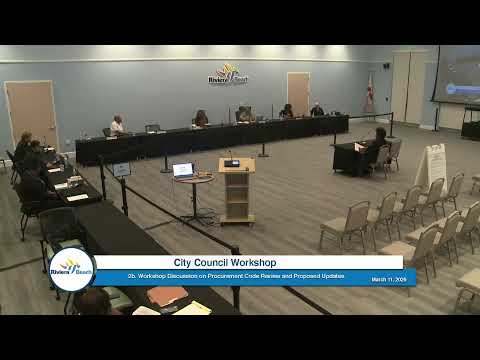
At a March 11 workshop the Riviera Beach procurement director presented a package of proposed revisions to the city's procurement code intended to modernize procedures, increase transparency and encourage local vendor participation.
"Procurement is the heart of an organization. We protect public funds. We protect fairness and access," Procurement Director Latana Ammons told the council as she outlined six focus areas: definitions, the purchasing office's duties, procurement and competitive methods, protest procedures, the cone of silence and a local vendor preference.
Thresholds, purchase orders and reporting
Ammons asked the council to consider raising the city's public solicitation threshold (the current threshold is $25,000) to $50,000 or $100,000 for non‑construction purchases and to require purchase orders for spend above a modest threshold with narrow exceptions (rent, utilities, recurring monthly charges and emergency PC‑card purchases). She said neighboring municipalities use higher thresholds and cited efficiency gains from reducing the number of formal solicitations.
Council members pressed for checks and transparency if thresholds are raised. "If we do this, we should get monthly reports from the city manager," Council person Dr. Glenn Spiritis said, stressing the need to monitor where funds flow. Several councilmembers said signing authority for manager‑level awards must be explicitly limited to goods and professional services and not be used for employment or severance agreements.
Data, disparity study and Prism integration
Councilmembers repeatedly raised the long‑standing request for vendor classification data needed to complete a disparity study. Procurement and the city manager said the city contracted Prism for data and is integrating it with the city's financial system; staff set an internal target of October 1 to begin producing classification reports that can be run monthly. "We are moving expeditiously to have it fully implemented so we can begin to run the data... starting October 1," City Manager Jonathan Evans said.
Protests, cone of silence and local preference
Ammons proposed clarified protest procedures and a protest bond (her draft suggested 5% of the protestor's bid or $5,000, whichever is less). Councilmembers debated increasing the bond and landed on the need to calibrate the amount for major projects. Staff also proposed starting the cone of silence when solicitations are publicly released to prevent selective outside communications; several councilmembers preferred keeping the cone start at solicitation closing to match county practice and to preserve permitted internal staff briefings.
On local preference, Ammons proposed two paths: for IFBs, a cost‑differential adjustment (a price preference calculation) and for RFPs, a modest point bonus (5% of points) for verified Riviera Beach businesses. Councilmembers asked staff to research subcontracting plans and tools to prevent "dog‑and‑pony" presentations where named subcontractors are replaced after award.
Council direction and next steps
Council did not adopt threshold changes at the workshop. Members split on increasing the solicitation threshold; several favored keeping the current $25,000 ceiling or applying higher thresholds only with mandatory monthly reporting. The board asked staff to draft ordinance language, provide examples from peer cities, and return with reporting templates and a Prism implementation timetable. Procurement will also recommend precise protest‑bond amounts and definitions for "local business" in the code.
"If there's something that looks wrong in the monthly reports, the council should have the ability to act," one councilmember said; staff committed to draft language that preserves the council's oversight while updating procurement operations.
The procurement discussion will resume at a future meeting after staff provides the requested ordinance drafts, sample reports and vendor classification output.