Get Full Government Meeting Transcripts, Videos, & Alerts Forever!
Get email alerts on the Comprehensive Plan topic
No spam. Unsubscribe anytime.
Riviera Beach council reviews major comprehensive‑plan overhaul; staff seeks direction on neighborhoods, housing and coastal resilience
Summary
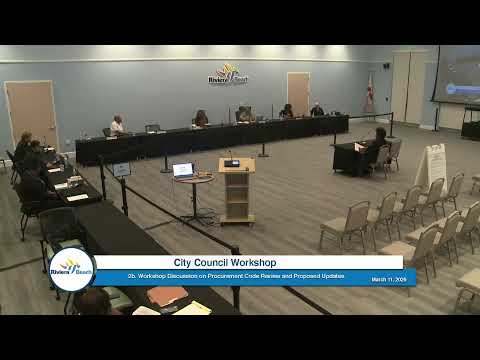
At a March 11 workshop staff and consultants presented a comprehensive update to Riviera Beach's plan, proposing neighborhood action plans, a new general mixed‑use land‑use category, explicit policies for unhoused residents and adaptation action areas for coastal resiliency. Council asked for clearer implementation schedules and continued public engagement.
Staff and consultants presented a broad overhaul of Riviera Beach's comprehensive plan at the city council's March 11 workshop, asking for direction on neighborhood action plans, a new mixed‑use future land use, housing policies for unhoused residents and coastal adaptation measures.
Development Services Director Surmans told the council the draft is the product of multiple years of outreach and is designed to reflect state changes such as SB 180. "We have drafted what you have been provided in your backup as the draft comprehensive plan for Riviera Beach," Surmans said, noting the plan must be transmitted to the state after first reading for coordinated agency review.
Consultant Graham Long, who led the update for Calvin Gardano and Associates, said the plan had not been comprehensively updated since 2010 and that staff and consultants aimed to modernize terms and add new elements. "The purpose of the comprehensive plan update is manyfold," Long said, summarizing the outreach (open houses, business workshops, stakeholder meetings and online surveys) and the guiding principles—safety, equity, resiliency, prosperity, neighborhoods and livability.
Key proposed changes
- Neighborhood action plans: Staff proposed restoring neighborhood‑specific plans with pilot efforts beginning this year, intended to address distinct local needs rather than a one‑size‑fits‑all future land use approach. Surmans said staff aims to begin implementation in‑house and, where budget allows, use consultants for targeted projects.
- General mixed‑use designation: The draft replaces a narrow office designation with a broader "general mixed‑use" category that would allow compatible combinations of residential, commercial and office uses to encourage corridor beautification and walkability. Council members pressed staff to explain how that designation would map to existing zoning districts and to clarify height and density implications; Surmans said the plan lists compatible zoning districts and that specific zoning regulations would be set later in the land development code.
- Housing and the unhoused: The housing element adds policies to preserve existing housing, expand workforce and affordable housing and explicitly addresses people the draft calls "unhoused." Surmans said the draft now supports transient housing in appropriate districts and recommends policies to connect residents to programs; councilmembers urged coordination with the Palm Beach County School District's McKinney‑Vento supports for children.
- Mobility, infrastructure and coastal resilience: The transportation element was reframed as a mobility element covering bikeways, freight, port access and vision‑zero goals. Staff added updates to water‑supply planning and proposed adaptation action areas to focus resiliency measures along different parts of the coastline. Surmans said the plan incorporates a coastal specialist's recommendations in the supporting documents.
- New economic and community resources elements: The draft includes an economic development element (with market analysis) intended to foster job growth and support local businesses, and a community resources element to capture school‑facility coordination and city programs not previously written into the plan.
Legal and special preservation issues
Special counsel Amy Patrick advised adding language to the comprehensive plan that mirrors the city's standalone ordinance on floating structures and live‑aboard vessels so the plan and ordinance do not conflict. She also discussed how the plan should treat judicially determined vested rights and noted that implementing language for certain zoning or land development rules may follow as separate land‑development code changes.
What the council asked for
Councilmembers repeatedly asked for concrete implementation steps, timelines and accountability measures. Several members stressed that neighborhood plans should be actionable, not merely conceptual, and asked staff to return with schedules and pilot details. Members also requested that the city continue public outreach (including a youth council briefing) and keep the project website and comment channels open through the planning & zoning board hearings and first reading.
Next steps
Staff said the draft will go to the Planning & Zoning Board for a statutorily required public hearing, then to council for first reading and transmittal to the state for coordinated agency review; staff will incorporate agency comments before bringing a final ordinance back for adoption. Suited to be a living document, staff also said the plan's format will include short executive summaries for each element to improve public access and ongoing monitoring.
The council did not take a formal vote on the plan at the workshop; staff was directed to return with clarifying materials, implementation timelines and opportunities for additional public engagement.