Get Full Government Meeting Transcripts, Videos, & Alerts Forever!
Get email alerts on the Acquisition Finance topic
No spam. Unsubscribe anytime.
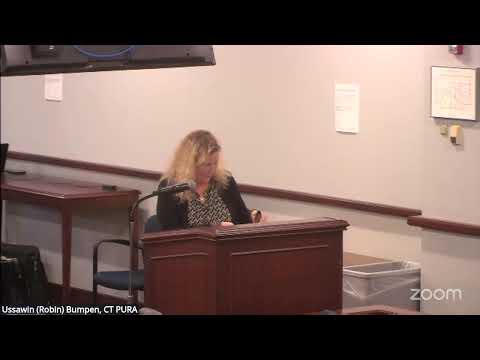
PURA oral arguments highlight deep split over Aquarion sale, with critics warning of decades of rate increases
Summary
At oral argument on Docket 254403, consumer advocates, towns and the attorney general urged the Public Utilities Regulatory Authority to reject the Aquarion change-of-control application, warning a $2.35 billion purchase and roughly $494 million acquisition premium would saddle customers with long-term debt and uncertain savings; applicants say the authority model yields lower long-term costs.
The Public Utilities Regulatory Authority heard hours of oral argument in Docket 254403 as parties debated whether Aquarion Water Company27s proposed sale and conversion to the Aquarian Water Authority (AWA) and the South Central Connecticut Regional Water Authority (RWA), under Eversource Energy27s bid framework, is in the public interest.
Consumer advocates, municipal intervenors and the state urged PURA to reject the transaction, saying the financial terms will force Aquarion customers to pay acquisition and debt costs for decades. Claire Coleman of the Office of Consumer Counsel told commissioners the Superior Court27s remand does not prevent PURA from performing a full public-interest review and warned the record shows customers ‘‘will be forced to pay the principal and interest on the purchase price’’ over a multi-decade period.
The Attorney General, William Tong, urged the authority to stand by its November denial and not to approve a deal the state believes is ‘‘not in the public interest.’' Tong pointed to applicant modeling and PURA27s draft findings showing a total lifetime financing burden of roughly $5.895 billion (including interest), and cited projected near-term rate increases of 6.5% to 8.5% from 2027 through 2035 under the applicants27 scenarios.
Towns serving Aquarion customers pressed related concerns about the loss of local tax revenue (PILOT), the lack of prior local consent in this enactment, and the potential for a conflict of interest when RWA participates on both sides of cost-allocation and governance decisions. Town counsel argued the enabling statute does not impose a legislative mandate to approve the sale and urged PURA to consider the lack of local support in the public-interest calculus.
Applicants and RWA/AWA representatives defended the transaction. Dan Cananan for RWA and Vincent Pace for Eversource said the authority model removes an equity layer and income taxes and gives access to lower-cost public borrowing, producing long-term savings for customers. They also told commissioners the 22modified offer of compromise22 (applicants27 commitments updating earlier filings) and pre-closing conditions can be enforced through pre-closing filings, bylaws, the representative policy board and, where necessary, superior-court remedies.
A central disagreement focused on how the acquisition premium and financing will be recovered. PURA staff and several parties used a working estimate of a $2.35 billion transaction price and a draft-decision27s arithmetic that yields a net acquisition premium on Aquarion books of about $494 million after specified adjustments; applicants said rounding and closing-date adjustments affect the precise number and pointed to additional projected savings from a lower cost of capital.
Parties also clashed over the proposed Office of Consumer Advocate (OCA) that would replace the state27s independent consumer counsel under the authority model. PURA previously found the OCA27s proposed staffing and independence insufficient; intervenors said nothing in the remand record fixes that shortfall, while applicants said the OCA is embedded differently in an authority and will be strengthened by the commitments in the record.
Commissioners asked detailed questions about which portions of the modified offer of compromise are enforceable pre-closing, how closing-price adjustments will be calculated, and whether PURA27s decision-making is constrained by Public Act 24-127s text. Several parties warned that accepting applicants27 untested commitments without evidentiary hearings would raise due-process concerns; applicants argued the commitments are in the record and that parties waived a late request for cross-examination by not seeking a hearing within the scheduling rule window.
PURA did not vote at the hearing. Commissioners said the matter remained under advisement with a final decision scheduled under the docket calendar; the authority had indicated a March 25, 2026 decision date in its schedule. The hearing record will be central if commissioners opt either to impose conditions that must be met before closing or to deny the application for failure to meet the public-interest standard.
The case will be watched for its implications on regulatory oversight of water systems, how acquisition premiums are treated in cost-of-service planning, and whether a public/quasi-public authority model will be permitted to supplant traditional rate regulation in Connecticut.
Ending: PURA27s decision will hinge on whether commissioners credit applicants27 projected long-term savings and enforceable commitments enough to offset immediate acquisition and financing impacts on Aquarion customers, or whether the authority will reject the transaction as not meeting the public-interest standard.