Get Full Government Meeting Transcripts, Videos, & Alerts Forever!
Get email alerts on the School Greening topic
No spam. Unsubscribe anytime.
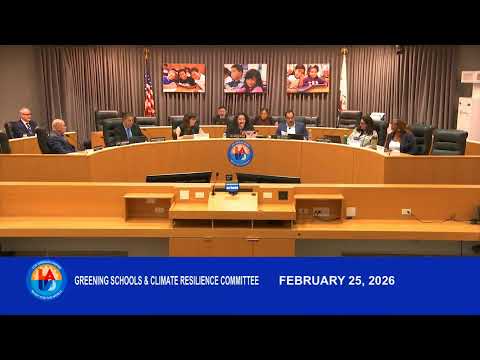
Greening advocates press Los Angeles Unified to unlock bond funding and reimburse nonprofit partners
Summary
The Living Schoolyards Coalition told the committee it has raised roughly $57–58 million and greened or is greening 52 campuses, but partners say district fees, bond‑process hurdles and site contamination are shrinking project scope and delaying work; the coalition urged district action on reimbursements and project inclusion in the strategic execution plan.
Nonprofit greening partners told the Greening Schools and Climate Resilience Committee that community‑led projects are producing schoolyard forests, expanded tree canopy and asphalt removal, but that implementation is being slowed by district fees, unclear bond procedures and site remediation costs.
"We have either greened or are in the process of greening 52 campuses," Michaela Randolph of Green Schools America said. "Collectively we have planted or plan to plant over 1,700 trees." She told the committee coalition partners have raised about $57 million to date to support campus greening.
Robin Mark of Salt Landscape Architects said the coalition appreciates a board resolution that allocated $3 million to cover district costs, but added partners have not been reimbursed and said accessing the roughly $1.25 billion set aside for greening within Measure US remains difficult in practice. Mark described projects that were substantially downsized after unexpected remediation costs — for example, Miles Avenue Elementary, where lead‑painted asphalt and contaminated soils raised cleanup costs and forced a reduced scope.
"Because of the high costs associated with this contamination, the project scope had to be whittled down," Mark said, describing a stark difference between original plans and the work completed.
Caleb Hirs, an attorney advising the coalition pro bono, summarized a legal review concluding that the bond authorizations for Measures RR and US, and state school bond law, generally allow bond funds to be used for capital greening projects and related ancillary costs such as inspections and ADA work — but he emphasized that the details will be technical when projects are added to the district's strategic execution plan.
Tori Jur, executive director of LA Neighborhood Land Trust, said partners have raised roughly $58 million and are asking the district to (1) cover project‑management/soft costs so nonprofit funds go into physical improvements, (2) reimburse nonprofits for fees already paid to the district (Tori said payments and change orders for one site approach $600,000), and (3) create a path for smaller or partially funded projects to access bond dollars so more schools receive meaningful greening.
District staff explained the board's $3 million allocation came from general funds and was distributed in a way tied to partners' grant amounts; staff said the initial distribution covered an estimated 5% of partner grant amounts and could be used either as direct checks to partners or to cover district fees. Facilities staff and coalition members discussed the bond oversight committee role in approving additions to the bond project list and the practical need to define projects clearly at scoping so associated soft costs can be treated as bond‑eligible.
Coalition leaders said they will present to the bond oversight committee and continue working with district staff to develop practical pathways for project inclusion and reimbursement.