Get Full Government Meeting Transcripts, Videos, & Alerts Forever!
Get email alerts on the Climate Literacy topic
No spam. Unsubscribe anytime.
Los Angeles Unified adult-education unit expands climate literacy and green-job pathways
Summary
Division of Adult and Career Education staff told the committee they have rolled out climate literacy lessons and ESL sustainability modules, trained climate champions at multiple campuses, and expanded CTE pathways in electric/hybrid vehicle maintenance, solar and electrician trades with employer partnerships.
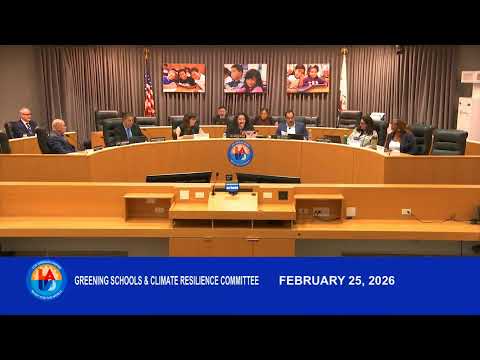
The Greening Schools and Climate Resilience Committee heard a presentation from the Los Angeles Unified School District's Division of Adult and Career Education on efforts to boost climate literacy and connect adult learners to green careers.
"Climate literacy and environmental stewardship start at the individual level," Matthew Oberlander, director of equity and instruction for the division, told the committee, adding that teacher‑generated resources exceed 100 lessons and an ESL environmental sustainability module has been completed by more than 9,000 students. Oberlander said the resources have reached over 2,000 students to date.
The division also highlighted a climate champions program that places volunteer staff at campuses to lead activities such as Earth Day events, teacher training and community gardens. "At eight of our 11 campuses, staff members have volunteered to serve in these positions and are making an impact," Oberlander said.
Michelle Cohen, one of the climate champions at LA Technology Center, described producing plain‑language newsletters for adult ESL students and converting an unused corner of campus into a community garden where students practice English, share plants from home and gather weekly. "It's really great that we have the garden to take a break in and get involved in," Cohen said.
Oberlander also reviewed career‑technical education (CTE) expansions tied to the green economy: an electric and hybrid vehicle maintenance pathway that served two campuses last year and 70 students this year; a solar installation program that enrolled more than 280 students last year; and an electrician program that served about 245 students last year and over 270 so far this year. He said the division is coordinating with the Port of Los Angeles on upskilling employees (about 175 workers) and is joining the California Heat Pump Partnership to update classroom equipment.
Committee members pressed presenters on how to expand pre‑apprenticeship (MC3) programs and the constraints that limit growth. Oberlander cited two recurring barriers: finding qualified CTE faculty who often earn more in industry than in teaching, and securing infrastructure and equipment at additional sites. "When an industry is in demand, the people who work in that industry are making more money. So it's less likely they're going to want to teach," he said.
The committee and presenters discussed outreach strategies — including counselor partnerships, regional events and targeted marketing — to recruit students into bridge courses and summer programs aimed at seniors not pursuing college. The presentation concluded with a request for continued board and committee support for CTE teacher recruitment, site approvals and program scale‑up.
The committee did not take formal action on the presentation; staff said they would continue to develop partnerships and report back.