Get Full Government Meeting Transcripts, Videos, & Alerts Forever!
Get email alerts on the Vehicle Weight Fee topic
No spam. Unsubscribe anytime.
CTC staff presents AB 251 vehicle-weight study, stops short of recommending a weight fee and suggests voluntary safety rating program
Summary
California Transportation Commission staff briefed stakeholders on a draft AB 251 study finding heavier passenger vehicles are correlated with increased harm to vulnerable road users but concluded a weight-based fee is unlikely to change consumer behavior unless set very high; staff proposed a voluntary motor-vehicle nonoccupant safety rating as an alternative and invited public comment through April 1, 2026.
California Transportation Commission staff on a public workshop presented a draft report prepared under Assembly Bill 251 (2023) that examined how passenger vehicle weight relates to injuries and fatalities of vulnerable road users and to roadway degradation, and that offered draft legislative considerations for the state legislature.
Kayla McDonald, who manages the study for the Transportation Commission, summarized academic findings and task force input, saying the research shows passenger vehicles have grown in size and weight over recent decades and that vulnerable road-user fatalities and serious injuries—particularly for pedestrians and bicyclists—have increased. McDonald cited trends from 2010–2022 showing a 71% increase in pedestrian fatalities and a 20% increase in bicyclist serious injuries, and said child pedestrians face a higher fatality risk when struck by taller vehicles such as SUVs.
The report found larger vehicles transfer greater kinetic energy in collisions and that hood height and vehicle front-end geometry affect fatality risk, but staff emphasized the research does not establish vehicle weight as the sole causal factor because crashes also involve speeding, weather, distraction and other variables. Regarding roadway damage, staff said passenger vehicles contribute negligibly compared with commercial trucks, noting axle configuration and loads, not gross weight alone, drive pavement wear.
On policy options, the academic modeling included two fee structures. Researchers modeled a one-time weight-based point-of-sale fee (the model figure cited was $3,871) that they said could reduce demand for heavier vehicles and generate substantial revenue, while a modeled annual registration fee of roughly $235 would likely be too small to change purchase behavior. McDonald said the modeled fees scaled by vehicle weight (with a threshold near 3,800 pounds) and that the one-time model used approximately $5 per pound; she said the annual-per-pound figure was in the modeling appendix and that staff did not set or endorse specific fee amounts.
After reviewing the evidence and task force deliberations, staff concluded that implementing a passenger vehicle weight fee is not being recommended because a fee large enough to influence purchases would impose significant costs and political and administrative challenges. McDonald outlined conditions the legislature should consider if it nevertheless pursues a fee: calibrate amounts by weight, account for administrative feasibility and cost, protect equity for low-income and disability-affected vehicle owners, avoid disincentivizing zero-emission vehicle adoption, and direct revenues to roadway and safety investments that benefit vulnerable users.
As an alternative or complement, staff proposed a voluntary California motor-vehicle nonoccupant safety rating program to provide consumers with information on how vehicles perform for occupants and people outside the vehicle. The proposed program would be voluntary, could be administered in partnership with private industry and nonprofits, and aims to incentivize manufacturers through market signals; staff said administrative costs for such a program are unknown.
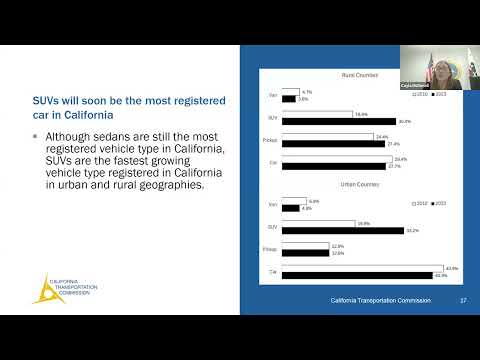
During a question-and-answer period, attendees asked whether the study compared crash shares by vehicle type to vehicle registration shares; McDonald said the crash distribution was roughly proportionate to registration shares but varies by geography and referred listeners to slide 19 and Appendix B for detailed comparisons. She also said pedestrian behavior was not a primary focus of the study and again pointed to the academic appendix for deeper analysis. McDonald repeatedly encouraged reviewers to consult Appendix B for model details and to submit written comments by April 1, 2026.
Next steps: the draft report and appendices are available on the Commission website, staff will use public comments to finalize the report, and the Transportation Commission will discuss the material at its March 19–20 meeting before the Commission considers a final report for approval and transmittal to the legislature.