Get Full Government Meeting Transcripts, Videos, & Alerts Forever!
Get email alerts on the Parking Enforcement topic
No spam. Unsubscribe anytime.
Committee approves amendments to commercial-vehicle parking penalties, sends bill forward
Summary
The Land Use & Transportation Committee voted to approve four amendments simplifying nighttime and residential commercial-vehicle parking fines (tiered $500/$250) and to exempt certain disability mobility-device trailers; the amended bill was recommended favorable to the City Council and agencies agreed to coordinate implementation.
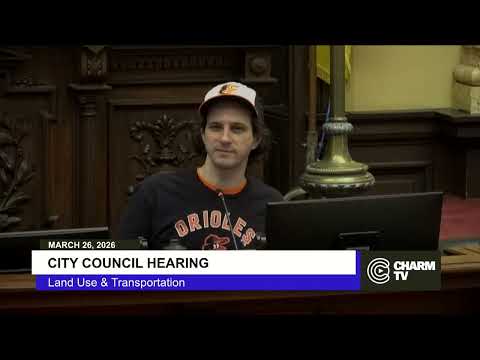
The Baltimore City Land Use & Transportation Committee on March 26 approved a set of amendments tightening commercial-vehicle parking rules and clarifying penalties, then recommended the amended bill favorable to the full City Council.
Chair Ryan Dorsy described four sponsor amendments designed to simplify and reassign penalties and close ambiguous language in the code. Under the amendments, very large commercial vehicles (Federal Highway classifications 6 and higher, including box trucks and semi-trailers) face a $500 fine for prohibited parking in residential areas or during the no-parking window from 1 a.m. to 7 a.m.; smaller commercial vehicles and trailers would face a $250 fine. An amendment carves out an exemption for trailers used to transport disability mobility devices (for example, heavy battery-powered wheelchairs). Another amendment removes redundant wording to make enforcement practicable.
The committee voted by voice to adopt the four amendments and then to move the amended bill favorable to the council. No roll-call tallies were recorded in the hearing transcript.
Implementation: Agencies agreed the change would require minor technical updates. Finance (Gabriel Stewart) said revenue-collection systems could be updated with moderate effort; DOT and BCIT will coordinate on handheld devices; BPD currently uses paper citation books but can record the ordinance language in-citation when necessary. The sponsor asked for a city-administrator memo and agency training so officers can identify vehicle classes and apply the new fines consistently.
Next steps: The amended bill will be transmitted to the full City Council with a favorable recommendation. Implementation details (handheld updates, training, and interagency coordination) were left to the mayor's office and the city administrator's office to direct.