Get Full Government Meeting Transcripts, Videos, & Alerts Forever!
Get email alerts on the Zoning Smoke Shops topic
No spam. Unsubscribe anytime.
Council hearing on smoke-shop zoning advances to April after major enforcement and mapping questions
Summary
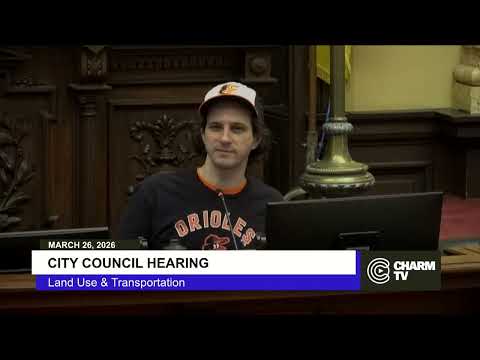
Baltimore City's Land Use & Transportation Committee held an extensive hearing on a bill to define and restrict smoke shops, including a proposed 10-linear-feet test and a buffer increase from 500 to 1,000 feet from schools/parks; agencies flagged enforcement, state preemption, and grandfathering challenges and the sponsor recessed the matter to April 16 for amendments.
Councilman Blanchard told the Land Use & Transportation Committee on March 26 that a package of zoning changes aimed at halting the rapid spread of smoke shops in Baltimore would be heard and further refined, but that the panel needed more time to resolve enforcement and legal questions.
Blanchard, the sponsor, said the proposal would create a new land-use definition for "smoke shop," set minimum distances from schools, parks and recreation centers, and change zoning tables so that smoke shops would generally be a conditional use in commercial districts and disallowed in residential and open-space zones. "Smoke shops and vape shops are at the heart of the vaping crisis with our youth," he said, describing storefronts that "crowd out the types of businesses we want in our main streets." He urged committee members to consider amendments drafted after feedback from agencies and the planning commission.
Why it matters: Sponsors and public-health advocates said high neighborhood density of these outlets normalizes nicotine and unregulated products near children and damages commercial corridors. The committee debated two technical choices with practical enforcement implications: how to measure whether an establishment qualifies as a smoke shop, and how large the setback from schools and parks should be.
Key details from the hearing:
- Definition and measurement: The bill originally used a percentage-of-floor-area test; after agency feedback sponsor proposed measuring "10 linear feet" of product display as a simpler field test an inspector can verify with a tape measure. Planning and BMZA staff supported the change as more administrable.
- Buffers: The sponsor said a 500-foot buffer to schools/parks was the original draft but that a 1,000-foot buffer was proposed following data showing 38 smoke shops within 500 feet of schools and 253 within 1,000 feet. Council leadership backed the larger buffer.
- Grandfathering and registration: Committee members pressed whether existing, legally licensed sellers would be "grandfathered" and whether they must apply for a new use-and-occupancy (UNO) or register. Officials discussed models used for liquor and short-term-rental rules and said options include a one-time registration period or an affidavit-based legal-nonconforming registry; several agency staff warned that registration could look like a licensing regime and might trigger state preemption concerns.
- Enforcement and resources: BMZA and planning staff cautioned that a "primarily engaged" or revenue-percentage trigger is easy to evade and hard to verify; they recommended either a clearer measurement rule, a dedicated licensing regime at the state level, or adding city enforcement resources (BMZA, a GIS analyst, field inspections). Finance estimated historic license activity (2014'025 average ~234 licenses a year; excluding one high year ~119/year) and BMZA estimated roughly 30 new zoning applicants a year if tracking increases; officials said a dedicated GIS analyst would cost roughly $106,000/year fully burdened.
- Illegal product sales: Sponsor and BMZA representatives said many shops display products that are not state-approved tobacco or nicotine devices and sometimes illegal cannabinoid products; BMZA and the state Alcohol, Tobacco, and Cannabis Commission (ATCC) have tools to pursue illegal sales but council staff said local zoning is a complementary way to limit physical proliferation.
Public voices: Ava Hodston, a downtown resident and economic-development board member, told the committee eight smoke shops sit within two blocks of her apartment and said the density harms neighborhood vitality and youth health. Laura Hail of the American Heart Association backed the bill, citing Baltimore's high licensed-tobacco establishment density in statewide data.
What happened: After extensive agency reports and member questions, Chair Ryan Dorsy recessed the hearing to April 16 to allow the sponsor to draft amendments and for staff to advise on registration language, UNO changes and potential state preemption risks. The committee did not take a final vote.
Next steps: The committee will reconvene on April 16 to consider sponsor amendments and further agency guidance. If the panel advances the bill, additional technical language will be needed to define measurement methodology, grandfathering rules, and an enforcement pathway that avoids state preemption problems.