Get Full Government Meeting Transcripts, Videos, & Alerts Forever!
Get email alerts on the Facility Operations topic
No spam. Unsubscribe anytime.
Robin outlines heating, ventilation and safety challenges at aquatic center
Summary
Presenter Robin described how outdoor slides that ice in winter force staff to keep them running, creating a trade-off between heating the pool and heat loss through slides; she also explained ventilation and condensation-control measures and why a persistent chlorine smell signals low free chlorine.
Presenter Robin described the aquatic center’s construction, use and operational challenges during a presentation in the facility’s auditorium.
"The space was built in 2011," Robin said, adding that the center "does see hundreds of kids every Friday, Saturday and Sunday" and functions as informal childcare on days without school. She said heavy weekend use contributes to staffing and maintenance demands.
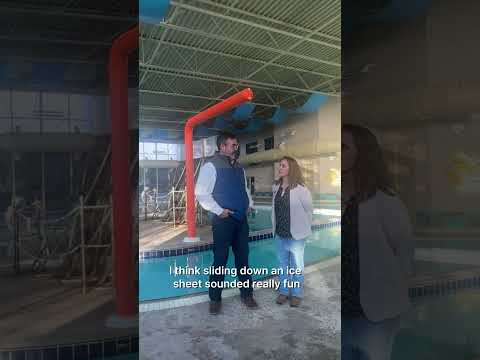
Robin said one recurring problem is the location of the water slides. "They built the slides outdoors which doesn't make sense in Wyoming," she said, describing how ice can form on the slides in winter. She said staff "have to have it run continuously" to prevent ice buildup, explaining that otherwise "the water freezes in there and it takes a long time for it to melt," and that frozen slide surfaces can cut children.
A meeting participant interjected after that description, saying the notion of "sliding down an ice sheet sounded really fun until you said cut," a comment that underlined safety concerns in the room.
Robin also explained the facility’s air-handling setup. Pointing to overhead ducting she called a "giant hamster tunnel," she said the system mixes warmed air with outside air to keep conditions fresh and to limit pool-related emissions. "We have to keep [the air] a couple degrees warmer or as warm as the water," she said, noting the water temperature was "82 to 84°" as stated in the meeting. She said matching air and water temperatures prevents condensation on windows, using the analogy of moisture in a shower.
On odor control, Robin said the absence of a chlorine smell is intentional: the fresh-air mix dilutes gases. She added that when people do smell chlorine it usually "means that your chlorine is low in the water because it's escaping as a gas," which is not desirable. A participant replied that hotel pools can smell that way when chlorine is low.
No formal motions or votes were recorded in the provided transcript. The discussion focused on operational explanations and safety considerations; next steps, staffing changes or capital fixes were not specified in the transcript.