Get Full Government Meeting Transcripts, Videos, & Alerts Forever!
Get email alerts on the Utility Fees topic
No spam. Unsubscribe anytime.
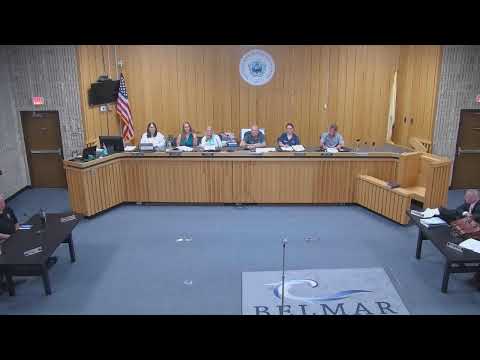
Belmar council advances first reading of water‑sewer connection‑fee ordinance after lengthy workshop
Summary
The Belmar Borough Council introduced an ordinance to establish water‑sewer connection fees (first reading approved), prompted by decades of capital investment in the utility; staff and NW Financial explained the statutory EDU calculation, and council raised affordability concerns ahead of a second reading.
Belmar Borough Council members voted to introduce, on first reading, an ordinance establishing connection fees for the borough's water and sewer utility after a lengthy workshop discussion about the size and scope of the charge.
Council members and staff described the fee as a statutory, formula-based charge assessed to new connections so that new users share in past capital investment rather than receiving service for free. Brendan Hansen of NW Financial, who the council asked to present the calculation, said the fee is derived by dividing system capital costs by equivalent dwelling units (EDUs); Hansen said the EDUs used in the analysis are defined in statute (described in the presentation as 28 gallons per day) and that the high fee — about $8,000 per EDU — reflects decades of infrastructure investment going back to 1980.
The council emphasized the fee applies only when a new water connection is required (new construction, conversion, addition or a change of use) and does not affect current customers with existing service. "This is not applying to current customers," the mayor said when members asked whether long‑term residents would be charged; staff reiterated the ordinance language covers only new connections. Council members pressed for more context and comparators and asked staff to circulate the statute text, the draft ordinance, and the NW Financial working papers before the second reading.
Council members also raised concerns about affordability for individual homeowners. One member said the $8,000 figure "feels so expensive" and noted many households cannot absorb large, unexpected costs; other members urged that the council use the intervening time before the second reading to gather comparative data from neighboring municipalities and to make the underlying audits and calculations available to the public.
The ordinance (listed on the agenda as the water‑sewer utility department establishing connection fees) was offered for first reading and introduction; roll‑call responses recorded council members voting to advance the ordinance for a second reading at the next meeting.
The council made clear the fee calculation is statutory and that adjustments or exemptions that would selectively apply to some new users but not others are not permissible under the statute. NW Financial explained the formula factors in capital costs, grants and debt service and then divides by the EDU measure to arrive at the per‑unit charge. Staff said applications for hardship time payments may be made to the mayor and council if the fee would create a hardship in an individual case. The council also noted the first reading provides an opportunity for additional questions and public review before the ordinance is scheduled for final consideration.
The council did not set a final effective date for any fee in the first‑reading action; a second reading and vote are scheduled for the next meeting, and staff committed to making the statutory method and the financial worksheets available to council members and the public.