Get Full Government Meeting Transcripts, Videos, & Alerts Forever!
Get email alerts on the Student Phone Policy topic
No spam. Unsubscribe anytime.
Weaver Middle School rolls out ‘Yonder’ phone pouches to curb classroom distractions
Summary
Weaver Middle School staff described a districtwide rollout of barcoded 'Yonder' phone pouches for grades 6–8 to reduce phone-related disruptions, increase student engagement and limit the online spread of fights; staff said the program includes teacher training, library checkout and procedures for emergencies.
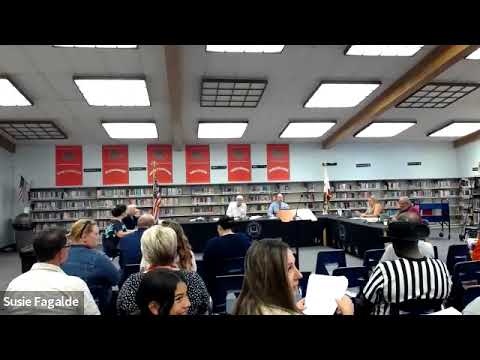
Weaver Middle School staff told the Weaver Union School District board that the school has issued barcoded 'Yonder' phone pouches to every student in grades 6–8 and is already seeing reduced phone-related disruptions and higher engagement in class.
The presenters said the district worked with Yonder to develop an implementation plan that included teacher professional development, three informational parent meetings (one virtual) and library-managed checkout so each pouch is assigned and trackable. "They are in currently and so here you can see in this photo a tag with a barcode," a district presenter said, describing the pouch-checkout process. Staff said the barcodes let the library identify students who left a pouch on a bus or elsewhere and return it to the correct student.
School staff and the board cited several reasons for the policy: fewer students taking out phones during class, fewer incidents of recorded fights or restroom photos being posted online, and teachers reporting stronger on-task behavior and increased Chromebook use. The presentation summarized vendor-reported outcomes from other districts — "84% saw improvement in student engagement; 72% saw improved behavior; 68% saw improved performance" — and said the district hopes to replicate those gains locally.
Board members asked about grade levels, logistics and safety: staff confirmed the pouches are for sixth through eighth grades, that students who arrive late check out a pouch in the front office, and that a small supply of loaner pouches is kept in lockers with students writing their names on a Post-it as a temporary record. On emergency access, one board member asked whether locking phones in pouches could impede communication in a shooting or other event. The presenter replied that safety procedures require teachers to move students to a predetermined safe area and only then permit controlled access to phones. "Our first priority is to make sure the students are safe," the presenter said, adding that law enforcement supported rehearsed protocols and that unfettered parent calls during lockdowns often complicate response efforts.
The program also defines consequences for students found with phones outside pouches: staff said the first instance leads to a parent pickup and that teachers are not expected to search pouches but to follow the established disciplinary procedure when a phone is visible. Board members noted the approach relies in part on an honor system; staff acknowledged occasional noncompliance but said they already see improvements in classroom focus and fewer incidents that spread on social media.
Next steps: staff said they will continue monitoring the program’s effects and report back to the board with data on disciplinary incidents and any concerns that arise around emergency procedures or logistics.