Get Full Government Meeting Transcripts, Videos, & Alerts Forever!
Get email alerts on the Right To Counsel topic
No spam. Unsubscribe anytime.
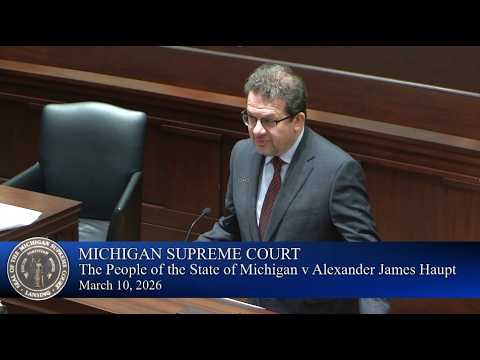
Michigan Supreme Court hears arguments in People v. Alexander Ha over when defendants must re‑waive right to counsel
Summary
At a mini-argument the court examined whether a defendant who previously waived counsel must receive fresh, full advisals after months of self-representation and counsel turnover. Lawyers debated MCR 6.005(D)/(E), —waiver by conduct— and whether pretrial proceedings here were —critical stages.—
Lansing, Mich. — The Michigan Supreme Court heard argument on May 12 in People v. Alexander Ha over whether a defendant who once waived the right to counsel must be given a new, full waiver after a substantial lapse of time and periods of self-representation.
Defense attorney Stuart Freriedman, appearing for Alexander Ha, told the court the relevant timeline began in April 2018 and emphasized gaps and changes of circumstance before a court-appointed lawyer later appeared. Freriedman said the trial judge should have given the full Foretta/Anderson-style advisals summarized in MCR 6.005(D) when Ha again proceeded without counsel, and he argued the eight-month interval and subsequent evidentiary rulings meant the absence of counsel could not be cured later.
—There were rulings that struck my client's witness list and the complainant was excused,— Freriedman said, arguing those consequences could not have been corrected by later counsel who had only one day to prepare the motion to suppress. He asked the high court to consider whether the trial record supports reversal because the initial waiver was not knowing and intelligent given the changed circumstances.
A justice pressed whether, after a defendant has invoked the right to counsel and later re-invoked self-representation, a court must as a per se rule require a new full waiver or instead apply a fact-specific test that accounts for time and intervening conduct. Freriedman cited cases from other jurisdictions and told the justices that courts look at change of circumstances and passage of time; he said an eight-month gap is longer than in many reported decisions.
The prosecutor, Autumn Wilma, urged the court to deny the application. Wilma said Ha expressly waived counsel in October 2018 and then engaged in conduct that manipulated and delayed proceedings, citing the line of authority that treats extreme, deliberate tactics as relinquishing the right.
—The defendant intentionally manipulated and delayed this case,— Wilma told the court, arguing the record supports a finding of waiver by conduct and that none of the counselless pretrial stages here are established critical stages whose deprivation would mandate reversal.
Justices and counsel debated how to draw the line between ordinary, common-sense behavior by criminal defendants (rejecting a plea, changing lawyers) and the type of egregious, obstructive behavior that courts have found can forfeit or waive counsel by conduct. The bench repeatedly returned to whether the trial court's failure to provide the warnings required by MCR 6.005(E) at subsequent proceedings is reversible error or a trial-court error subject to harmless-error review.
Counsel and the justices also discussed a separate factual issue: whether an absent complainant could or should have been subpoenaed (counsel referenced Army regulations and the possibility of certification to secure attendance), and the record shows the trial judge conditioned use of a prior transcript on whether the complainant actually appeared; she did not.
The parties finished their time and the case was submitted for decision. The high court did not indicate a timetable for ruling.
People v. Alexander Ha concerns the scope of court rules and constitutional protections that apply when a defendant moves between self-representation and appointed counsel, and the decision could affect how trial courts handle subsequent advisals and remediation questions when counsel changes or delays occur.