Get Full Government Meeting Transcripts, Videos, & Alerts Forever!
Get email alerts on the Historic Preservation topic
No spam. Unsubscribe anytime.
Residents urge landmarking and limits on farming in John Osborne Homestead management plan hearing
Summary
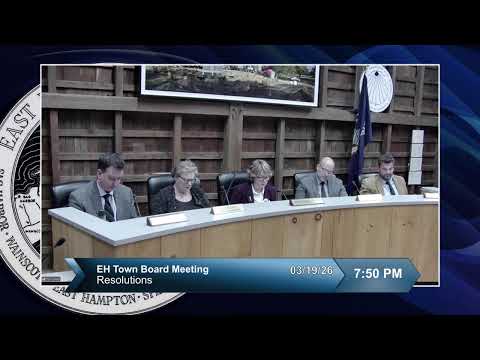
At a March 19 Town Board hearing on a draft management plan for the John Osborne Homestead (66 Wainscott Main), residents and local heritage groups urged the town to landmark the full parcel, avoid large-scale active farming near Wainscott Pond, and prefer low-impact public access such as mowed paths rather than paved loops.
The East Hampton Town Board heard hours of public comment March 19 on the draft management plan for the John Osborne Homestead, a 66 Wainscott Main property the town acquired in December 2024 and designated at least the buildings as a historic landmark in March 2025.
Residents, preservationists and civic groups told the board they support the town’s acquisition but pressed for stronger protections in the draft guidance document. Esperanza Leon, president of the Wainscott Heritage Project, urged the board to "landmark the entire parcel" — not just the structures — and to manage the surrounding 28–30 acres so the site’s historic character and adjacent wetlands are preserved.
Speakers from the Wainscott Citizens Advisory Committee and the Wainscott Heritage Project suggested several specific edits to the draft. Hersey Egginton, chair of the WCAC, read a letter recommending the plan eliminate the possibility of intensive active farming on the site, noting the draft lacked limits on acreage, deer fencing, irrigation, or use of fertilizer-intensive methods. The WCAC recommended a preference for a low-impact “mowed in-and-out” trail over an impervious multi-use loop to protect the open viewshed and wildlife habitat.
Several speakers emphasized water-quality risks. Kim Quarty of the Friends of Georgica Pond said Wainscott Pond is “extremely impaired” and that upland practices that increase nitrogen loading would risk harmful algal blooms; Quarty asked the board to prioritize management strategies that protect water quality and to permit only low‑nutrient or novel agricultural practices (for example, apiaries or hydroponics) if any agriculture is allowed.
Longtime residents and artists framed the issue as visual and cultural as well as environmental. Bruce Wayne Solomon and John Stoner recounted family histories and historic aerial photos that they said show the parcel has functioned as an open meadow for decades; both asked the town to preserve the pastoral vista and avoid infrastructure — including deer fencing and large irrigation systems — that they said would alter the landscape irreversibly. Abby Fleming, a Wainscott teacher, and Terry Elkins, a local artist, reiterated opposition to asphalt paths and supported simple, low‑impact access to the pond.
Town staff (Scott) told the board the draft, dated Jan. 29, 2026, is meant to be a guidance document for how the property may be used and to provide flexibility for future boards; he noted one factual correction to the draft (the garage doors slide rather than roll up and the upstairs has one bathroom rather than four en suite bedrooms) and said some suggestions had already been incorporated. The property management committee reviewed the revised draft and had no further proposed modifications at its January meeting, Scott said.
The public hearing closed after callers and in‑person speakers delivered comments urging greater specificity in the plan to protect the viewshed, water quality and historic setting. Several speakers asked the board to consider formally designating the entire parcel as a local historic site before finalizing the management plan so the land’s protection would be codified in the document.
The Town Board did not take a final vote on the management plan during the March 19 meeting; next procedural steps were not specified during the hearing.