Get Full Government Meeting Transcripts, Videos, & Alerts Forever!
Get email alerts on the Firewise Community topic
No spam. Unsubscribe anytime.
Los Gatos leaders, fire officials and residents push Firewise neighborhood certification to boost wildfire resilience
Summary
Town Manager Chris Constantine and Santa Clara County fire officials led a Firewise orientation in Los Gatos, outlining the Firewise certification steps, home-hardening measures and local mitigation projects; residents described their Teracita neighborhood’s experience and asked about insurance, hazardous trees and alert systems.
Town Manager Chris Constantine and Santa Clara County fire officials led a public Firewise orientation that urged Los Gatos neighborhoods to organize for wildfire preparedness and certification.
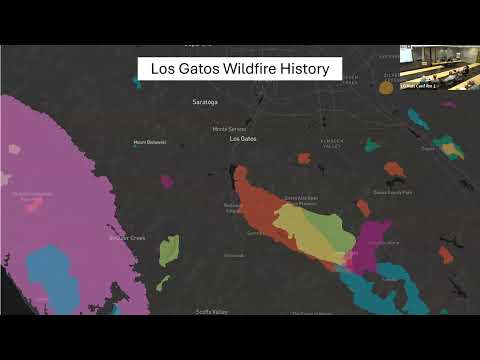
Town Manager Chris Constantine said the session was meant to “bring the neighborhoods together and kind of give you the tools and resources” to reduce wildfire risk and walk participants through the Firewise USA certification process. He reviewed county-level risk data and local drivers of risk — “fuel, weather, and topography” — and noted that high local property values increase estimated loss in national risk indexes.
The presentation described current mitigation work around the town, including vegetation treatments (the speaker cited roughly 240 acres treated around the hillsides) and a planned 31 miles of road-clearance buffer to improve access and reduce fuels. County fire representatives also described sensor and satellite monitoring supported by partners such as San Jose Water to improve early detection.
Battalion Chief Skyler Thornton of Santa Clara County Fire described his department’s role in community outreach and said the department conducts risk assessments for neighborhoods that begin the Firewise application process. Andrea Constantine of the Santa Clara County Fire Safe Council explained how the council assists residents with surveys, assessment coordination and preparing the required documentation for NFPA review.
Residents from the Teracita neighborhood — Jason Kings and Peter Herat — recounted their experience becoming Firewise certified. Kings said the neighbors used a Google Form to collect home-level data, coordinated a community assessment with county fire, revised their first submission after CalFire feedback, and then achieved certification. “Firewise certification doesn’t mean you’ve eliminated all risks of fire,” Kings said. “It just means we’re recognizing that these 33 households have committed to work together to get better.” Herat added that, in their 33-household group, only a single household resisted fuel-reduction activities and that volunteer work parties (for example, removing scotch broom) helped build momentum.
Speakers gave concrete home-hardening and spacing guidance: the home ignition zone focuses on roughly 100 feet around a house; ember-resistant vents, Class A roofing, noncombustible siding or fences, and removing combustible mulch close to structures were cited as key measures. The presentation cited after-action findings used by insurers and fire professionals: discrete ignitions tend to occur with 30–70 feet spacing between structures, while rapid house-to-house conflagrations occur when spacing is 8–14 feet; wind-driven fires increase the importance of hardened materials and, for forward-facing exposures, about 20 feet of spacing was identified as beneficial.
Insurance and renter issues were a recurring concern. Constantine told attendees that insurers now look more closely at forward‑looking climate risk and home- or community-level mitigation. He encouraged residents to contact their insurers and noted renters should consider renters insurance because many displaced people after past wildfires were renters and expected homeowner policies to cover them.
Audience members asked about several practical issues. On tree removal and arborist coordination, Town Manager Chris Constantine said the town is reviewing tree ordinances from a fire-risk perspective and will coordinate with fire staff; he advised residents to report imminent hazards to code enforcement for evaluation. On notifications, fire officials urged residents to opt into Alert SCC (county emergency management) and the Genesis Protect app (fire department geo‑fenced evacuation notifications), explaining that the systems serve different but complementary roles and residents may need to sign up for multiple services to receive countywide and real-time evacuation alerts.
Panelists emphasized that Firewise is a voluntary, continuing commitment: communities must organize, complete a community assessment and a three‑year action plan via the NFPA/Firewise portal, and log at least a minimal amount of annual education or mitigation activity (presenters said a baseline of one hour per house per year is the certified minimum, with money spent on contractors convertible into equivalent hours). County and community partners offered to mentor neighborhoods through the portal and inspection process; a signup sheet was available for follow-up assistance.
Mayor Matthew Hudis, attending from the audience, praised the community volunteers and said the town would continue to look at larger mitigation investments but that household‑level actions matter. Constantine closed by encouraging attendees to organize, sign up for local alerts and use available partner resources to pursue Firewise certification in their neighborhoods.
The orientation ended with offers of follow-up support from county fire and local Firewise neighbors; presenters said they would share the recording with those who provided contact information and invited signups for inspections and mentoring.