Get Full Government Meeting Transcripts, Videos, & Alerts Forever!
Get email alerts on the Telecommunications topic
No spam. Unsubscribe anytime.
Developer appeals denial of 170‑foot communications tower in St. Augustine Shores PUD
Summary
Applicant appealed a Planning & Zoning denial for a 165–170‑foot monopole in the St. Augustine Shores PUD, saying the tower fills a service gap and supports public‑safety prioritization; opponents (appraisers and Realtors) testified it would be visually intrusive and could depress nearby property values.
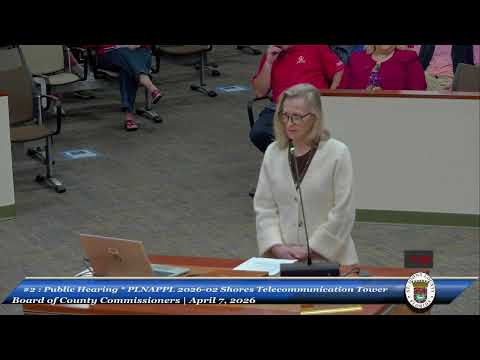
The board began a quasi‑judicial hearing on an appeal of a Planning & Zoning decision denying a special‑use permit for a 165–170‑foot communications monopole within the St. Augustine Shores PUD.
Applicant representatives (including Brad Wester and David, CEO of Next Tower) said the parcel chosen is a five‑acre commercial/business tract in the PUD, that the proposed 165‑foot monopole (plus lightning rod) meets separation and setback requirements, and that county third‑party review confirmed radio‑frequency models showing a coverage gap the tower would remedy. David of Next Tower said co‑location for AT&T, Verizon and T‑Mobile and prioritized public‑safety access (AT&T FirstNet, Verizon Frontline) were central to the need for the height and placement.
The applicant argued the PUD contemplates “telephone” and essential public services, and that denying wireless infrastructure in practice would be an effective prohibition contrary to federal and state law, which prohibit local decisions that effectively deny wireless service. The applicant asked the board to reverse the PNC denial, saying the denial lacked substantial competent evidence.
Opponents included professional witnesses and residents. Ron Moody, a state‑certified appraiser, testified the visible tower would be “detrimental and significant” to nearby property values and cited published studies and local appraisal data suggesting reductions of up to 20% in some cases. Realtor Elizabeth Michaels said the tower would appear in listing photos and drone images and would deter buyers, lengthen days on market, and lower appraised values. Other public speakers reiterated aesthetic and compatibility objections.
Commissioners queried alternatives, site selection rationale and whether smaller “street‑facing” unit poles or mid‑cells could substitute. Applicant and technical witnesses said modern 5G equipment requires larger mounts and specific heights for coverage and that small cells would require many more installations along rights‑of‑way, which could be even more intrusive.
Legal and planning questions remain: whether the PUD’s essential‑services language covers modern wireless infrastructure in the way the applicant asserts, whether the denial rests on subjective aesthetics rather than code criteria, and whether there are feasible, less intrusive alternative sites that meet engineering requirements. The designated public‑comment phase was under way at the end of the provided transcript; no final board decision on the appeal appears in the supplied text.
What’s next: the hearing will continue to allow cross‑examination and rebuttal; the board must weigh the county’s land‑use criteria, the applicant’s coverage and public‑safety claims, and testimony from appraisers and residents on compatibility and economic impact before issuing a legal determination.