Get Full Government Meeting Transcripts, Videos, & Alerts Forever!
Get email alerts on the Municipal Budgeting topic
No spam. Unsubscribe anytime.
Franklin City Council weighs alternatives to a proposed 4‑cent real‑estate tax increase
Summary
Councilors spent an extended session discussing five options to address a roughly $312,000 shortfall tied to debt obligations and rising liabilities, including across‑the‑board cuts, a meals tax increase paired with a smaller real‑estate hike, eliminating planned employee compensation increases, and trimming school non‑SOQ funding; no final budget was adopted.
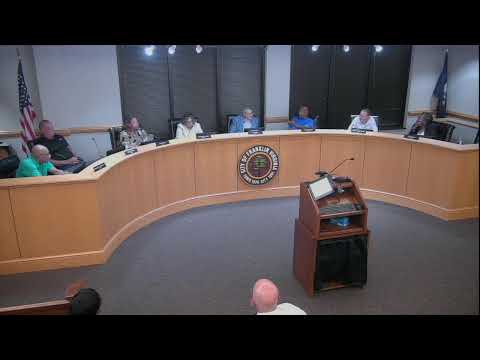
Franklin City Council used a special meeting to re‑examine the city’s budget gap and consider ways to avoid a proposed 4‑cent increase to the real‑estate tax.
City Manager briefed council that long‑term debt obligations, recent accounting for compensable absences and prior reliance on transfers and fund‑balance withdrawals created structural pressure on the general fund, producing a roughly $5.88 million budget gap in the broader planning context and a near‑term shortfall of about $312,000 tied to the 4‑cent real‑estate change. The manager said the real‑estate tax yields roughly $77,775 per penny and warned that some previously used balancing methods were unsustainable.
Staff offered five options for council consideration: 1) modest across‑the‑board departmental cuts (example: a 1.5% reduction yielding roughly $324K); 2) a combination of a meals (food and beverage) tax increase and a smaller real‑estate increase (staff estimated a 1% meals tax would yield about $115K); 3) a meals tax combined with targeted cuts; 4) forgoing planned employee compensation increases (the manager said this would preserve current tax levels but widen the city’s regional pay gap); and 5) reducing the city’s proposed non‑SOQ school funding (staff supplied state SOQ templates showing required local effort versus discretionary non‑SOQ allocations).
The manager summarized tradeoffs for each path: cuts risk reduced service quality and higher turnover (most acute for public safety), consumption taxes shift costs to residents and visitors, and reducing school non‑SOQ aid would force the school division to scale back optional programs or reallocate priorities.
Council debate ranged across priorities and risk appetite. Several councilors favored option 2 (use a meals tax plus a smaller real‑estate increase) to spread the burden and preserve employee compensation and core services. Other members urged more aggressive internal revenue generation and enforcement — for example, improving collections on event admissions and vendor sales, pursuing electronic billing to reduce postage costs, and leasing underused city land — and pressed for a forensic audit to clarify the status of restricted funds (for example, cemetery trust receipts) before deciding whether to cut city or school allocations.
A key point of contention centered on the schools’ projected Average Daily Membership (ADM). Staff said final ADM figures from the state typically arrive in June; because the council must adopt a balanced budget before the state numbers are finalized, members debated whether to reduce the city’s proposed discretionary school dollars now (some proposed reductions in the low‑hundreds of thousands) or accept a blended tax approach and revisit school allocations later. Several councilors warned that cutting school programs could harm students reliant on services the non‑SOQ funds support.
No final budget was adopted at the meeting. Councilors split in preference between a meals‑tax/partial real‑estate approach and combinations that included modest school funding reductions; the split prevented a consensus and staff reiterated the need for a decision prior to formal adoption. The council then moved to a closed session to interview candidates for the school board.