Get Full Government Meeting Transcripts, Videos, & Alerts Forever!
Get email alerts on the Land Management topic
No spam. Unsubscribe anytime.
Resident and small contractor pitch goat-based clearing; council asks staff to draft model ordinance
Summary
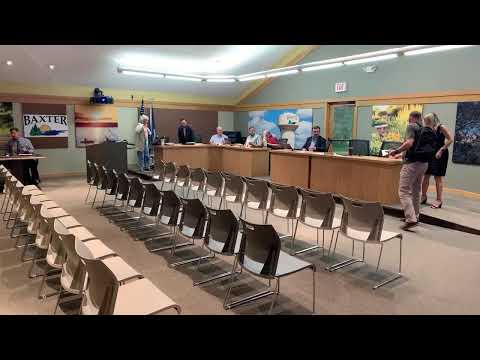
At a Baxter City Council meeting a resident and a representative of a land-clearing business urged the city to consider allowing temporary, supervised goat-based vegetation clearing to control poison ivy and invasive species; staff said Baxter lacks a specific ordinance and will research model rules and return with a draft.
Ron Morris, a Brainer resident and local property owner, told the Baxter City Council that several vacant lots he owns are overrun with poison ivy and invasive weeds and urged the city to consider allowing commercial goat-based clearing on private properties.
"The weeds, the poison ivy is a real problem there," Morris said, adding that he cannot safely inspect his lots because of his allergy. He said he has discussed the idea with local contractors and asked the council to direct staff to explore an ordinance that would permit supervised goat clearing.
A Persilla, who identified themself as representing Copper Sustainable Clearing, described how the company uses goats in portable enclosures as a temporary, supervised tool to remove invasive vegetation. "Our goats are not kept for livestock. They do not do any grazing in a traditional sense," Persilla said, adding that the animals are brought in temporarily, managed by handlers, and removed when the job is complete. Persilla cited a state study and said seed viability after passage is under 1 percent and that goats cause no soil compaction and produce no fuel emissions.
Council members asked practical questions about containment, shelter during storms and how long animals remain on-site; Persilla replied that the length of a job depends on vegetation density and size, estimating 10 to 15 goats could clear a light acre in about a week and that goats are transported back to trailers or home if weather requires.
City staff told the council that Baxter's existing animals ordinance classifies goats as livestock and that the city does not currently have a specific rule to authorize temporary, supervised goat-based clearing. "We don't have an ordinance that addresses this business concept," a staff member said, and offered to research model ordinances such as St. Paul's and return to council with a suggested draft.
Council members directed staff to prepare a model or suggested ordinance and to report back with potential rules and permitting language. The matter was not acted on formally and will return to council for further consideration.