Get Full Government Meeting Transcripts, Videos, & Alerts Forever!
Get email alerts on the Water Infrastructure topic
No spam. Unsubscribe anytime.
MRGCD and Sandia Pueblo sign agreement to replace Corrales siphon after BIA finding of trespass
Summary
At a special Corrales Village meeting, the Middle Rio Grande Conservancy District and Sandia Pueblo signed a right‑of‑way agreement to replace the Corrales Siphon after the Bureau of Indian Affairs told MRGCD it had not held a federally approved right‑of‑way. Officials say the project is fully designed and funded and construction is slated to begin January 2026.
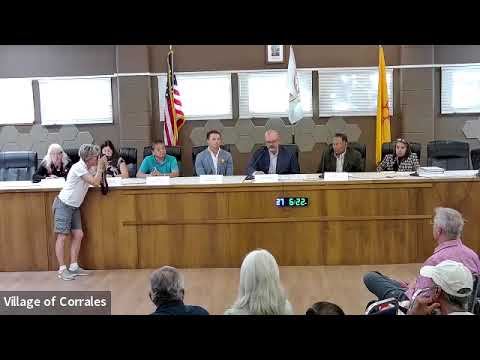
Jason Cassuga, chief executive officer of the Middle Rio Grande Conservancy District, and Governor Chavis of Sandia Pueblo signed a right‑of‑way agreement at a special Corrales Village meeting to replace the Corrales Siphon after a Bureau of Indian Affairs review concluded MRGCD lacked a federally approved right‑of‑way.
“The BIA found that MRGCD was in trespass with regard to the siphon,” Cassuga said, reading a prepared statement that traced the siphon’s damage, interim pump deliveries since 2022 and negotiations with tribal and federal partners.
Why it matters: the siphon — last used in the 2021 irrigation season before a sinkhole revealed extensive damage — serves irrigators in the Corrales service area. Cassuga said the replacement project is fully designed, that the New Mexico Water Trust Board committed $7.5 million and that MRGCD committed an additional $1.5 million, and that construction is scheduled to begin in January 2026.
During a question-and-answer period, Councilor Bill asked three specific procedural questions: whether the Bureau of Indian Affairs review and Indian Affairs requirements were addressed, the expected construction timeline, and whether the Water Trust Board had extended the funding payout window. Cassuga said MRGCD and Sandia Pueblo stand ready to file the BIA right‑of‑way application and that MRGC submitted a letter requesting a funding-extension first week of September; he said a construction contract has been awarded and is ready for a January start.
On the schedule, Cassuga said the awarded contract runs one year — a timeframe the contractor requested because directional boring under the river carries subsurface uncertainty — though the contractor could complete the pipe bore in roughly four months if geotechnical conditions are favorable.
MRGCD legal counsel said the district has held extensive pre‑application conversations with the BIA and the solicitor’s office and has done preparatory work designed to expedite the federal review once the application is filed.
Governor Chavis asked that MRGC forward final construction documents and the notice to proceed so Sandia Pueblo’s technical staff can coordinate staging and safety. Greg Kaufman, identified in the meeting as a Sandia technical team member, was described as having the latest drawings and contact information.
Cassuga also defended a recent late‑season water release to the Corrales area, saying a limited San Juan‑Chama allocation and reservoir releases created a rare opportunity to give Corrales irrigators one additional chance to water. “The purpose of releasing that water was to try to give Corrales and as many folks in Corrales one more opportunity to irrigate,” he said, and he said he would defend that decision before the district board if questioned by other counties.
The signing included mention of a signed warranty deed and a notary; officials exchanged thanks and noted the agreement represents a step in a long process requiring continued cooperation among the village, the district and tribal partners. Next steps described at the meeting: MRGC and Sandia Pueblo will file the BIA right‑of‑way application, finalize the Water Trust Board funding extension, and begin construction activity in January 2026 if federal approvals proceed on the expected timeline.