Get Full Government Meeting Transcripts, Videos, & Alerts Forever!
Get email alerts on the Transportation topic
No spam. Unsubscribe anytime.
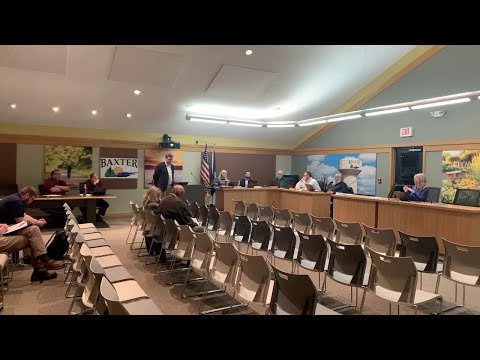
Baxter council disapproves MnDOT overpass plan with seven conditions, 3-2
Summary
After hours of debate about safety, local access and cost, Baxter City Council voted 3-2 to disapprove the Minnesota Department of Transportation(MnDOT) layout for the 371/210 grade-separation project but adopted a disapproval-with-conditions resolution asking MnDOT to meet seven specified conditions to convert the disapproval into approval.
The Baxter City Council voted 3-2 on a resolution declining municipal consent for the Minnesota Department of Transportation(MnDOT) proposed grade-separation at trunk highway 371 and highway 210, but tied that disapproval to seven conditions MnDOT must accept in writing to convert the decision into municipal consent.
The vote concluded a lengthy public meeting in which council members traded sharply different views about safety, local business impacts and the cost and appearance of a design that places a large retaining wall near Baxter—enter. Mayor Brad called the item and reminded the council the city has until Feb. 1 under Minnesota statute to act on MnDOT's request for municipal consent.
Why it matters: The project comes with a state funding offer of roughly $58 million toward addressing a long-standing safety and traffic issue at the 371/210 intersection. Supporters called the funding a once-in-a-generation opportunity to reduce crashes and long-term costs; opponents said the current layout sacrifices local access, alters the town—haracter and is an unproven design for the traffic volumes here.
Council debate and key positions came down to competing priorities. Council member Sunberg, who opposed the project as presented, said he had "five main points" and warned the plan "is going to change the look of this town um permanently," citing a 30-foot retaining wall, concerns about railroad-related geometry and the risk that local access has been deprioritized during design.
By contrast, Council member Mark said MnDOT had "brought roughly $60 million to the table to fix an issue that we've known about for 25 years," cited traffic studies and a 2022 memo estimating long-term crash-cost reductions, and argued the city should not forgo the funding.
Council member Cross raised fiscal and complexity concerns, noting that "the cost of $58 million, it's not free money," and urged attention to aesthetics, local business visibility and the project's local budget impacts, including an estimated local contribution in the low millions.
Motion and conditions: After discussion the council adopted option three (disapprove with conditions) and attached seven conditions the council wants MnDOT to meet in writing. The list, presented to council members and to MnDOT in packet materials, includes items such as posted speed reconsideration, coordinated wayfinding and business-access signage, post-construction monitoring at specific intersections with MnDOT commitment to evaluate and advance mitigation if the project causes operational or safety deficiencies, and other access-preserving measures. Council members clarified that under state law MnDOT has a limited period to respond; if MnDOT accepts the conditions in writing the city's disapproval becomes approval. If MnDOT does not accept them the agency may end the process or pursue statutorily available appeals.
Vote: The mayor called the vote; the clerk announced "two nos, three yes," and the motion carried 3-2.
Next steps: Staff will prepare the adopted resolution text with the seven identified conditions and forward it to MnDOT for a written response. MnDOT's response timeline and any appeal options are governed by state statute; council members said they expect MnDOT to reply in writing and that further action will depend on that reply.
What was not decided: The council did not adopt a final construction layout tonight; it instead used its single statutory vote to conditionally decline consent to preserve leverage for design changes. The council also did not finalize follow-up mitigation funding or specific aesthetic treatments beyond the conditions sent to MnDOT.
Authorities and supporting documents: The item was introduced as Resolution 2026-007 pertaining to municipal consent for state project 1809-98 (the trunk highway 371/210 grade separation). City staff cited Minnesota statute governing municipal consent and the Feb. 1 municipal deadline.