Get Full Government Meeting Transcripts, Videos, & Alerts Forever!
Get email alerts on the Wastewater Facility Plan topic
No spam. Unsubscribe anytime.
Consultant recommends dewatering facility and phased upgrades to meet future wastewater limits
Summary
A consultant presented a phased facility plan for Baxter-area wastewater treatment that prioritizes bio-solids storage and dewatering, recommends eventual conversion from sequencing batch reactors to activated-sludge biological nutrient removal if permit limits tighten, and outlined capital and O&M cost ranges and funding options. A public hearing and funding-submittal deadlines were announced.
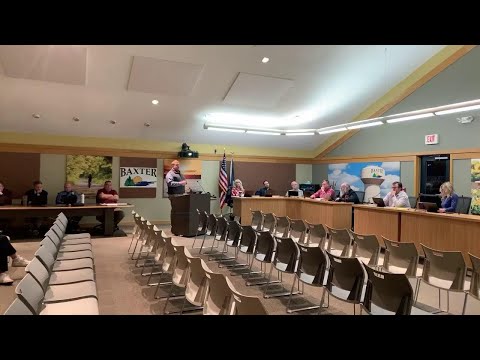
A consultant presenting the wastewater facility plan told the Baxter City Council the plant must address bio-solids storage and future nutrient limits to support projected community growth over the next 25 years. The plan identifies bio-solids storage and processing as immediate needs and outlines a three-phase approach: pre-treatment and bio-solids handling improvements, a potential conversion of the liquids stream to an activated-sludge biological nutrient removal (BNR) process if permit limits require it, and later additions such as heat-drying or thermal destruction for bio-solids.
Why it matters: The Minnesota Pollution Control Agency requires 180 days of bio-solid storage; the consultant said the plant historically fell short of that standard in 2014–2019 and has been at or near the requirement since 2022. Staff warned that increasing regulatory limits for nitrogen and phosphorus — and new monitoring or limits tied to permit cycles — could force design changes that affect capital spending, operating costs and consumer rates.
What the consultant presented: He described the existing treatment train — screening, grit separation, sequencing batch reactors (SBRs), ultraviolet disinfection — and the current solids-handling flow (thickening, digestion, storage, and land application). He reported current operational numbers and modeled future impacts: historically the plant used a 5,000-gallon truck and averaged roughly 1,000 truck trips (about 24,000 miles) to land-apply bio-solids; under projected growth scenarios staff estimated about 1,300 truck trips and roughly 33,000 miles annually if the land-application pattern remains unchanged. The consultant said a 2-million-gallon additional sludge-storage tank was one storage option, and that dewatering would substantially reduce truck trips and transportation miles.
Treatment alternatives and recommendation: The consultant reviewed five liquid-stream technologies and narrowed them to two feasible near-term alternatives: retain SBRs (the existing approach) or convert to activated-sludge BNR. He explained trade-offs: SBRs operate in single tanks and can require more energy and proprietary equipment, while activated-sludge systems use multiple tanks and clarifiers and are widely used nationally, easier to source equipment for, and more adaptable to future nutrient limits. His recommendation was to pursue a phased plan that builds dewatering capacity in the near term and preserves the option to convert the liquid stream to activated-sludge BNR when permit-driven limits make that step necessary.
Costs and operating impacts: The consultant provided capital-cost ranges and O&M estimates (presented as order-of-magnitude opinions): SBR upgrades were shown in the $58–72 million range; activated-sludge BNR conversion in the $70–88 million range; dewatering alternatives in roughly the $25–32 million range (with some slide references to $32–38M for certain combined scopes). He said baseline annual O&M for the treatment facility is about $5.2 million and that the recommended improvements would add roughly $500,000 per year for liquid-treatment O&M and about $100,000 per year for dewatering operations, with additional increases if heat-drying or thermal destruction units are added. The consultant also noted natural-gas-fired digesters and drying systems can drive large utility and maintenance costs.
Bio-solids disposal pathways: The consultant emphasized that land application is currently the primary disposal route and that land availability and regulatory limits (including new Minnesota PFAS-related guidance) have reduced effective acreage and complicated timing. He said converting to a dewatered Class B product at about 20% solids would reduce truck trips substantially (presented figures showed a decline from roughly 1,300 trips to about 150 trips annually in one scenario); further drying to a high-percent dry Class A product would reduce trips even more but would be a later-phase investment.
Funding and schedule: Funding sources identified included the Minnesota Public Facilities Authority (low-interest loans), Point Source Implementation Grants (PIG) that can cover a portion of eligible costs, affordability grants to reduce rate impacts, state capital bonding, assessments and federal appropriations. The consultant said facility plans are due in early March under state schedule, announced a public hearing before the Brainerd Public Utilities Commission on Tuesday, Feb. 24 at 9:00 a.m., and asked for council consensus to pursue funding applications (with some deadlines in early March). He recommended continuing preliminary engineering after preliminary MPCA acceptance and then advancing to design and bidding phases in 2027–28 for phase one, with construction windows to follow.
Council questions and takeaways: Council members pressed for clarity on rate impacts and timing. Staff and the consultant said phase-one improvements would be reflected in a rate study and that an illustrative figure for the treatment-only portion showed roughly a $50-per-month increase for an average user under one annualized scenario (the presenter emphasized that exact timing and magnitude would be defined in the rate study and by the availability of grants and loans). Several council members asked staff to pursue grants and direct appropriations to minimize local rate impacts.
What's next: The council was asked to support staff working with regional partners and the consultant to pursue funding opportunities and to finalize the facility plan for submission. The consultant recommended a decision matrix be developed to trigger conversion to activated-sludge BNR when permit limits mandate it.