Get Full Government Meeting Transcripts, Videos, & Alerts Forever!
Get email alerts on the Transportation topic
No spam. Unsubscribe anytime.
Gainesville prepares mobility-fee ordinance but pauses adoption pending state law review
Summary
City transportation staff and a consultant presented a proposed mobility plan and fee schedule. After discussion and a legal briefing that flagged Senate Bill 180 (2025) as a potential bar to adoption before Oct. 1, 2027, the commission directed staff to complete drafting but to withhold formal notice or adoption until legal risk is resolved.
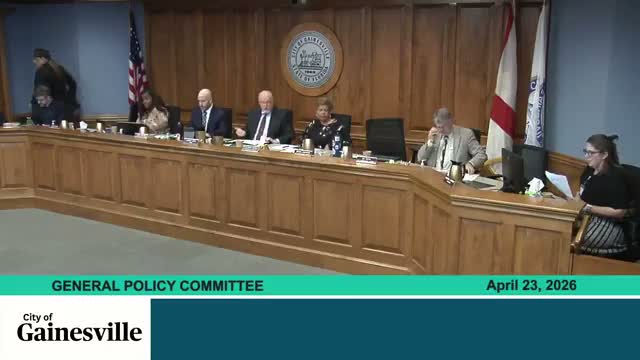
City transportation staff and a consultant told the General Policy Committee on April 23 that Gainesville needs a new mobility program: a mobility plan paired with a standardized fee schedule to replace the existing transportation mitigation framework.
Scott Wright, transportation staff, and consultant Jonathan Paul explained the proposal’s elements: five fee assessment zones (including a downtown/central zone), exemptions for single-family infill and other small changes of use, an exemption for developments that are 100% affordable, a 3‑year credit for previously existing uses, a separate category for electric vehicle charging stations (recommended at 50% of a gas-fueling station’s fee based on data), and a recommended four‑year phased implementation for areas newly subject to the fee.
Paul said the technical analysis supports the fees and that developers could submit site-specific studies to reduce fees where justified.
City Attorney Sean McDermott advised caution: Senate Bill 180 (2025) includes language that could allow residents and businesses to challenge local amendments that are “more restrictive or burdensome” and imposes a statutory timeline that, in McDermott’s reading, effectively bars adopting new comprehensive-plan or land-development code rules of this kind until Oct. 1, 2027 (or later if a covered hurricane triggers a statutory delay). He recommended finishing the ordinance work but not advertising or adopting it until the legal uncertainty is resolved to avoid costly legal challenges.
Commissioner Engel moved that staff continue preparing the draft ordinance and that the city hold off on formal adoption/advertising until staff and legal counsel confirm it is legally safe to proceed. The motion passed unanimously.
What happens next: staff will finish drafting the ordinance text and the implementing LDC changes, continue to refine policy questions (affordable-housing thresholds, the East Zone exemptions, the phase-in schedule) and monitor state legislative developments; the commission explicitly asked staff not to advertise for first reading until the state-law risk subsides.