Get Full Government Meeting Transcripts, Videos, & Alerts Forever!
Get email alerts on the Pollinators topic
No spam. Unsubscribe anytime.
UNM researchers warn of steep insect declines; Corrales adopts pollinator proclamation
Summary
UNM Museum of Southwest Biology staff told the Corrales Village council that insects are both highly diverse and rapidly declining in the Southwest, and the council approved a proclamation backing local pollinator protection and outreach.
On a recent Corrales Village council meeting, researchers from the University of New Mexico’s Museum of Southwest Biology (Division of Arthropods) told elected officials and residents that insect diversity is enormous but that many key groups—particularly butterflies and some bees—are declining in the Southwest.
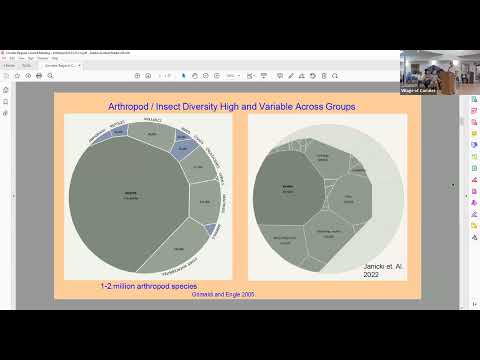
Dewey Devivi, a museum technician and research assistant, said insects account for the majority of described species on Earth and estimated current described insect species at roughly 1.7 million to 2.1 million, with many more still undescribed. He emphasized the regional severity: “In the last 20 years … butterflies in the Southwest have decreased by 54%,” he said, and summarized the broader process as, for insects, a “death by a thousand cuts” driven by drought, wildfire, invasive species, pesticide exposure and other cumulative stresses.
Devivi, joined at the meeting by Melanie Gonzalez, David Lightoot and Shannon Rollins, outlined monitoring gaps and the NM Rare catalog the team maintains to document species of conservation concern. He said only a small fraction of insects have IUCN-style conservation ranks and that local efforts to expand monitoring and assessments are underway. He highlighted several species found locally, including the Morrison bumblebee, the American bumblebee and the monarch, and recommended practical steps for residents: plant native species, participate in citizen-science platforms (for example, iNaturalist), and volunteer with monitoring networks.
During questions, council members and residents asked about mosquito control methods and pesticide risks. Devivi advised prioritizing targeted larval-control approaches and biological agents when feasible, and cautioned that broadcast aerial pesticides can be “very hard on bees,” including native bee species.
After the presentation, the council approved a proclamation read by the presenter that expresses the village’s support for pollinators and local agricultural interests. Mayor James F. Fehey Jr. and councilmembers moved and approved the proclamation by voice vote.
Why it matters: Pollinators underpin local agriculture and native plant reproduction; the presenters argued that local policies, outreach and monitoring can both inform regional conservation plans and reduce the risk of further declines.
What’s next: The UNM team encouraged local participation in monitoring efforts and noted that state-level pollinator protection work is underway; the village can use NM Rare data to guide local outreach and habitat preservation.