Get Full Government Meeting Transcripts, Videos, & Alerts Forever!
Get email alerts on the School Budget topic
No spam. Unsubscribe anytime.
City manager flags accounting gaps after schools say locality owes millions
Summary
City Manager Oglesby told a joint Franklin City Council–school board work session that discrepancies in accounting and reconciliation mean preliminary claims that the city owed the schools millions require verification; she described system, process and staffing gaps that complicate calculation of what, if anything, is due.
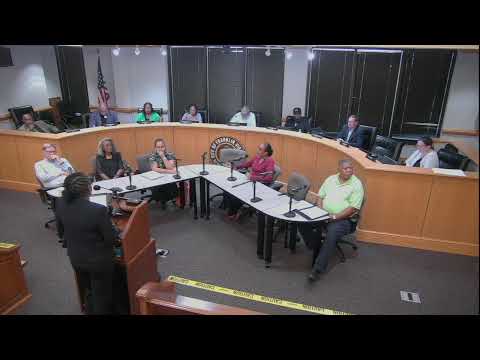
City Manager Oglesby told the joint Franklin City Council and Franklin Public Schools work session on July 28, 2025, that city and school accounting practices produced conflicting numbers about what the city may owe the schools for FY25 and that key reconciliations and supporting documents were missing.
"Tonight is just going to be a presentation to share the results of review the financial matter as it relates to the Franklin Public Schools FY25 operating budget," Oglesby said, describing the briefing as informational. She said school staff initially presented a worksheet claiming the city owed $2.7 million and later noted a figure that increased to $5.3 million.
The presentation focused on three concerns: legal appropriation limits and where authority lies; differences in accounting systems and reporting practices; and gaps in reconciliation, documentation and staffing that prevent the city from verifying the schools' claims. Oglesby emphasized that the city council, not the school board, sets appropriation limits and that preliminary enrollment (ADM) figures can change local‑match calculations.
Oglesby cited provisions of the Code of Virginia (transcribed in the session as "22.1100," "22.1-91" and "22.1-116") to explain that unspent local funds generally revert to the locality, that a school board may not spend or contract to spend in excess of available funds, and that the treasurer is charged with custody and disbursement of school funds. She said the treasurer must keep school funds in accounts separate from other city funds and that final settlement with the school board should occur by Aug. 15 for activity through June 30.
To reconcile the schools' position and the city's ledgers, Oglesby said staff must separate "appropriation" (the council's legal spending limit) from "spending" (what has actually been paid) and review encumbrances and roll‑forward requests. She pointed to specific items officials are rechecking: a $152,000 scanner purchase that the city shows as expended in FY24 and thus not eligible to roll forward; HVAC project amounts that Oglesby said should have been encumbered and rolled forward; and a separate $330,000 capital appropriation that requires the schools to request reimbursements when funds are expended.
Oglesby said a later meeting between the school's finance director and the city's interim finance director produced a higher claimed amount — $5.3 million — and that the city had not been prepared to accept preliminary totals without documentation. She explained that the schools operate on a cash‑based system (referred to in the presentation as RDA) while the city uses an accrual‑based system (referred to as admins), which produces timing and reporting differences.
The treasurer and Oglesby described a "zero‑based" banking arrangement used for school checks: school payments draw against a pooled account and are subsequently made whole, which complicates presentation of "due to" and "due from" balances in city reports when reconciliations are not done fund‑by‑fund.
Oglesby said auditors' reports did not reflect more than $1 million in outstanding school checks that staff had identified. She also said payroll liabilities that span fiscal years (for 10‑ and 12‑month employees) were not clearly reflected as liabilities in current reports.
The manager urged improved procedures: stronger documentation for change orders and project expenditures, routine fund‑by‑fund reconciliations between the schools' finance system and the city's accounting system, clearer encumbrance practice for capital projects and additional training or resources for finance staff.
There was a preliminary motion to approve the meeting agenda before the presentation; the transcript records a motion and second but does not provide a recorded roll‑call tally in the available text.
Next steps Oglesby identified include producing reconciled schedules and supporting documentation for the claimed amounts, clarifying which encumbrances legitimately roll forward, and returning to the council with verified figures before any appropriations are changed or additional funds released.